Main dishes, Recipes

Braised and Barbecued Pork Spareribs

OLYMPUS DIGITAL CAMERA

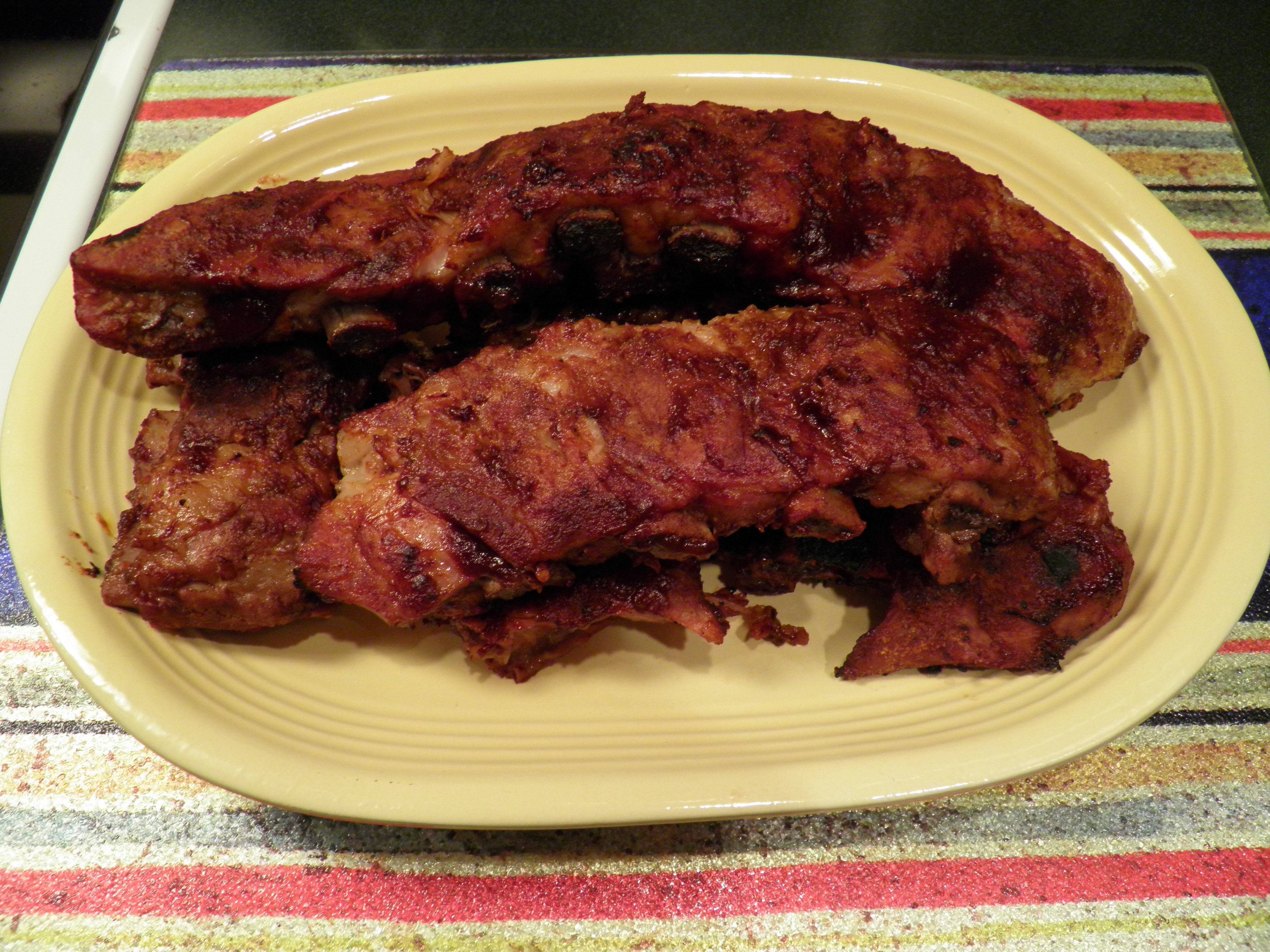
It used to frustrate me that I could never produce falling-off-the-bone spareribs at home.  I knew I must be doing something wrong, but I didn’t know what it was.  You barbecue them, right?  Then I watched an old Good Eats with Alton Brown, and I learned how to cook ribs.  As with my previous post, this one is more about the method than it is a recipe.  Producing good spareribs at home without a commercial smoker is a three-step process:  rub and rest, braise, then glaze on the grill.

Rub and Rest

You can use any kind of rub you like.  Montreal Seasonings makes a good pork rub.  I also like the barbecue rub I’ve found in the bulk spices section at WinCo.  I’m sure there are others.  But my current favorite is the one I used for my recent post about pulled pork.  I’ll post the rub recipe again here.  It can be made without the dried tomato skins, of course.

Pork Rub (with Dried Tomato Skins)

1 tablespoon dried tomato skin powder

1 tablespoon brown sugar

1 tablespoon kosher or coarsely-ground sea salt

¼ teaspoon cayenne pepper (optional, adjust to taste)

2 teaspoons hot smoked paprika (optional, regular paprika can be used)

½ teaspoon ground cumin

¼ teaspoon ground cinnamon

½ teaspoon garlic powder

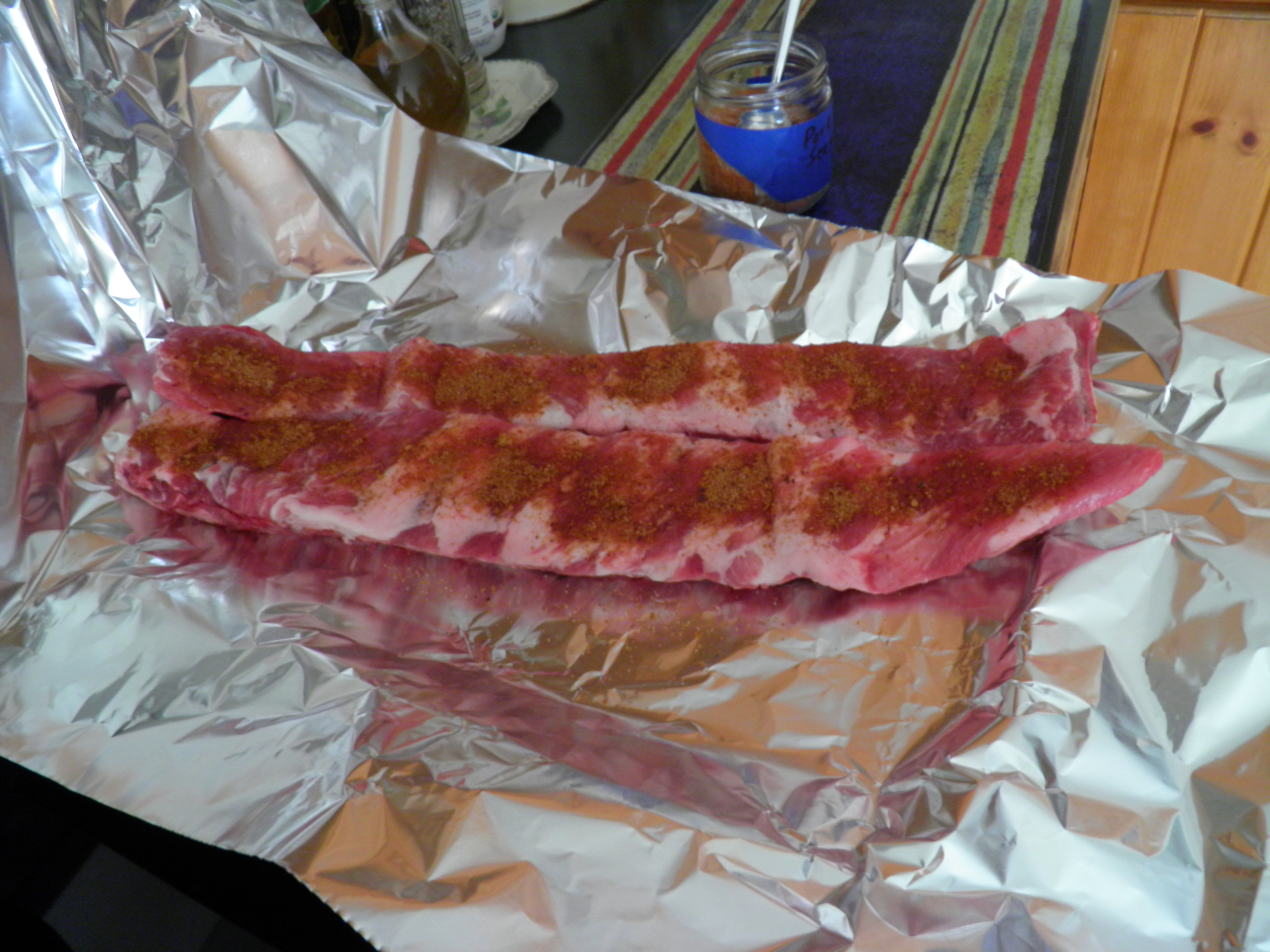
Sprinkle all sides of 3-4 lbs. of spareribs with 2-3 teaspoons of the rub, and . . .  you guessed it . . . rub it in.

OLYMPUS DIGITAL CAMERA

Create a packet from heavy duty aluminum foil that will hold your ribs, and leave one edge loosely sealed to create a place where you can easily uncrimp the foil to add your braising liquid later.  Place foil packet of ribs into a baking pan (not cookie sheet, just in case a bone punctures the foil) large enough to hold them, and put in fridge for 4-8 hours.  Then, it’s on to the next step.

OLYMPUS DIGITAL CAMERA

Braise

You can braise meat on the cooktop, in a crock pot, or in the oven.  For meat that needs to marinate first (which is what a dry rub does, even though it’s dry), I prefer the oven.   You can use a crockpot if you put the rub on the ribs and stash them in the fridge overnight, then put them in the crock pot in the morning for 6-8 hours, depending on hot your crock pot cooks and what temperature setting you use.  You can also braise in a Dutch oven on the stove top, keeping the braising liquid at a low simmer.  But the dry heat of the oven that surrounds your foil packet (or Dutch oven) produces, in my opinion, the best flavor in the ribs.  And using foil makes for easy clean-up.

To oven-braise, remove the foil packet of ribs from the fridge about 3 hours before you want to serve dinner, and let them sit out on the counter to warm up for about 15 minutes while you prepare your braising liquid.  Turn your oven on to 350 degrees.

You can use almost any liquid or combination of liquids to braise the ribs if you remember a few simple guidelines.  The braising liquid should be flavorful (so plain water isn’t a good choice), slightly sweet, and slightly acidic, but it should contain little to no added salt because of the salt that’s already in your rub.  This is where you can get creative and have some fun.  Here are some possibilities for braising liquids.  You’ll only need about 2 cups unless you are cooking more than 3-4 lbs. of ribs.

Lemon-lime soda, 2 tablespoons ketchup, 2 tablespoons Worchestershire sauce

Cola, ginger ale, or root beer with 2 tablespoons ketchup, 2 tablespoons Worchestershire sauce

Weak coffee, slightly sweetened with honey, brown sugar, or molasses

Lemonade or orange juice, 2 tablespoons ketchup, 2 tablespoons Worchestershire sauce

Tomato juice, 2 tablespoons of molasses or brown sugar, 2 tablespoons Worchestershire

Beer, 2 tablespoons of molasses, and ¼ cup of tomato sauce or 2 tablespoons of ketchup

Sake, 2 tablespoons of brown sugar, a tablespoon of low-sodium soy sauce (1/2 teaspoon of Chinese five spice powder is good with this one, or it can be added to the rub)

The variations are pretty much endless, depending on the flavor profile you want to create.  It isn’t often you’ll see me using an item like a can of soda in my cooking, but it really does work well in this application.  I used the first mixture on the list above for the ribs in my pictures this week.  I added to it a pinch of my Nigerian pepper (and I could have used more, but I have to watch the heat level for Dennis), and a ¼ teaspoon of espresso powder, and it smelled really good going into the meat.  It sounds like a strange mix, but it was really tasty, which is my point about getting creative with your braising liquid.

You can also add a drop or two of liquid smoke to mimic the flavor of a smoker, although you will get a bit of smoke flavor from the finish on the grill.  Because the braising liquid is going to become the barbecue sauce or glaze, and because I like a chunky sauce, I add a chopped onion and a couple of cloves of garlic, minced, to whatever braising liquid I use.  The sauce can be smoothed out in a blender or with a stick blender before glazing the meat, if desired.

Heat the braising liquid and any flavor additions, like sweeteners, more spice, onions, garlic, in a small saucepan that you can pour from (or as I did, heat it in a glass measuring cup in the microwave).  When all the ingredients have mixed, set it aside to cool slightly.  It should be warm, not hot, and the meat should be cool, not cold.  Open the foil packet of ribs just enough to pour in the braising liquid, and then close the foil up tightly.

OLYMPUS DIGITAL CAMERA

Place in oven at 350 degrees and cook 2-3 hours or until ribs are fork tender but not quite falling apart.  Remove the ribs from the oven, pour off the braising liquid, and leave ribs in foil packet to rest while you create the glaze and fire up the grill.

Glaze and Grill

If you have a fat separator, you’ll want to use it here to pour off the braising liquid and eliminate some of the fat that has cooked out of the ribs.  If you don’t have a fat separator, use a large spoon to skim as much of the fat off the top of the braising liquid as you can.  Then put the braising liquid back into the small saucepan and start it boiling.  You’ll probably have about 1 ½ cups of liquid.  If you have less than that, you might want to add a little more of whatever liquid you used to start with.  To the braising liquid, add about ½ cup of ketchup or tomato sauce, or ¼ cup of tomato paste.  Let this reduce a bit, and then check for seasoning and sweetness.  I almost always add some more molasses or brown sugar to my sauce because I like a fairly sweet sauce.  I think the flavor profile of a great barbecue sauce is spicy/tangy/sweet.  Think about the flavor profile you like and taste the sauce as it reduces, adding more sweetener, salt or pepper, liquid smoke (this can be very strong, so go easy, a drop at a time), or other flavors to get a sauce that tastes good to you.  Add just a bit at a time and keep tasting.  Reduce the sauce until it’s the consistency you like (some like thick, some not).  Blend the sauce if you want it smooth.

The ribs are done, so there’s no actual cooking left to do.  All you’re going to do is glaze your meat with the sauce.  You’ll want your grill at medium, not hot, so that the glaze doesn’t burn.  (You could do this under the broiler if you’re careful, but you won’t get the same flavor.)  The sauce has sugars in it, so if the grill is too hot, the sugars will burn instead of caramelize.  Paint one side of the ribs liberally with the sauce, place sauce side down on the grill and allow the sauce to bubble and brown on one side before turning.  It shouldn’t take more than five minutes per side to glaze the ribs.  Watch them carefully.  As I tell Dennis, do not walk away from the grill!

OLYMPUS DIGITAL CAMERA

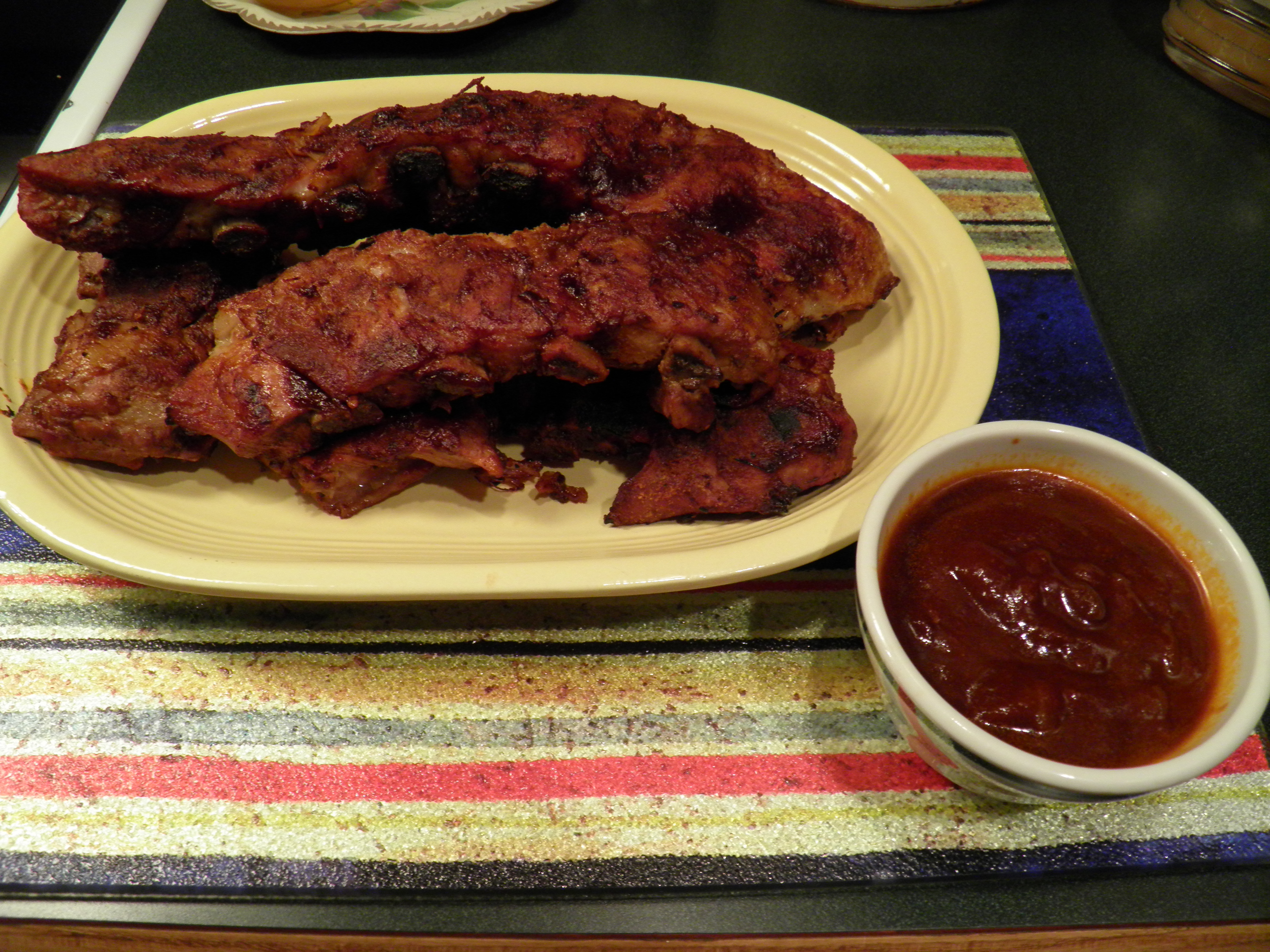
Serve your tender, braised and barbecued pork spareribs hot off the grill with the extra sauce for dipping.  If you accompany your ribs with the traditional sides–cornbread, coleslaw, greens cooked with bacon, onion and vinegar, and beans or black-eyed peas—you’ll think you’ve been transported temporarily to the South.  And if you still have leftover sauce after the meal, save it for barbecued chicken later in the week, or put it in the freezer.  It’s too good to throw away!

Standard
Leftovers, Main dishes, Recipes

Sublime Roasted Chicken Soup

I actually call this soup Everything But the Kitchen Sink Chicken Soup, or sometimes, it’s known in our house as Clean Out the Fridge Chicken Soup.  But that’s a pretty long title for a blog post.  So, to shorten it up, and to give credit to the technique that produces the delicious flavor of this soup, I went with Sublime Roasted Chicken Soup.  I had to throw in “sublime” because there are just way too many “the best chicken soup” posts out there in online foodie land.  I’m not saying I make the best chicken soup in the world.  I don’t have to.  My family says it for me!

My chicken soups are always made with the carcass from a roasted chicken, so let’s start there.  Roast chicken was one of the first things I taught my daughter-in-law to cook when she and my son were married, and it’s just about the easiest thing to put on a dinner table to feed a family.  What follows is more of a technique than a recipe, which allows you to use your own creativity (and eventually, your leftovers).

Roast Chicken

Season a fresh or thawed chicken, inside and out, with any of the following seasonings or get creative and make up your own:

1 tablespoon of Cajun seasoning mix (this is a blend of peppers, salt, and spices you can buy in the grocery store, and I like it a lot for chicken) OR

1 tablespoon Montreal chicken seasoning mix OR

1 tablespoon coarse sea salt mixed with 1 teaspoon freshly ground black pepper and 1 teaspoon dried crumbled sage and 1 teaspoon dried crumbled thyme (or a teaspoon of ground poultry seasoning)

Whatever kind of seasoning you choose, sprinkle it inside the body cavity and rub it outside on the skin, then place the chicken into a roasting pan or Dutch oven with a lid. I always cook my chicken in a roasting pan with a lid (so technically, it’s baked or braised, I suppose, not roasted) because the meat is always moist and juicy, and I don’t have to worry about basting.  This is easy-peasy chicken dinner!

If you want to fancy it up, you can stuff the body cavity with any sort of stuffing you like (I have a recipe for cornbread stuffing in another post) or with sliced lemons, onions, garlic, and a sprig or two of rosemary, and you can also place root vegetables like carrots and parsnips and potatoes around the chicken, if there’s room in the pan, when you’ve got about an hour of cooking time left.

Cook the chicken at 325-350 degrees for 2-2 ½ hours  (depending on the size of the chicken) or until the meat reaches an internal temperature of 160 degrees in the thickest part of the leg.  You can also tell the chicken is done when the meat on the drumstick starts to pull away from the bone and the thigh joint jiggles easily when you move the leg.

Remove the chicken from the roasting pan to a carving board or platter and cover it loosely with foil.  Let it rest until it stops steaming, about 20 minutes.  Don’t carve your breast meat while there is still steam escaping from the bird.  It will dry out.  If you stuffed the bird, remove all the stuffing as soon as you remove the bird from the oven.  Don’t let stuffing cool inside the bird.

Pour off the cooled pan drippings and refrigerate.  You can make gravy with the drippings, but there tends to be a lot of fat in it, so if you have one of those fat separators, it’s helpful for making gravy.  Cooling the drippings allows the fat to be scraped off the top, so you can use just the flavorful and nutritious drippings in your soup and discard the fat.  If you do make gravy, save any leftovers for adding to your soup, just like you would the drippings.  Enjoy your roast chicken dinner!

Dennis and I get at least 4 or 5 meals from one chicken.  We eat several meals from the roasted meat itself, and then, I make soup from the carcass.  Here’s how to get all the goodness from that chicken carcass.

Sublime Roasted Chicken Soup

First, place the carcass on a cookie sheet.  Rub a little olive oil on the exposed shreds of white meat that are left on the carcass and sprinkle it lightly with salt and pepper or the same seasoning mix you used before roasting the chicken.  Turn the chicken carcass upside down! Place in 400-425 degree oven for 15-20 minutes, or until the carcass is a golden, toasty brown color.

The reason for roasting the carcass again is two-fold.  First, roasting creates flavor and color in your broth.  (If you want clear, pale chicken broth like the stuff that comes out of a can, don’t roast.  But you won’t have nearly as much flavor.)  The second reason to roast is that the high heat on the bones helps them release minerals and nutrients into the broth or stock.

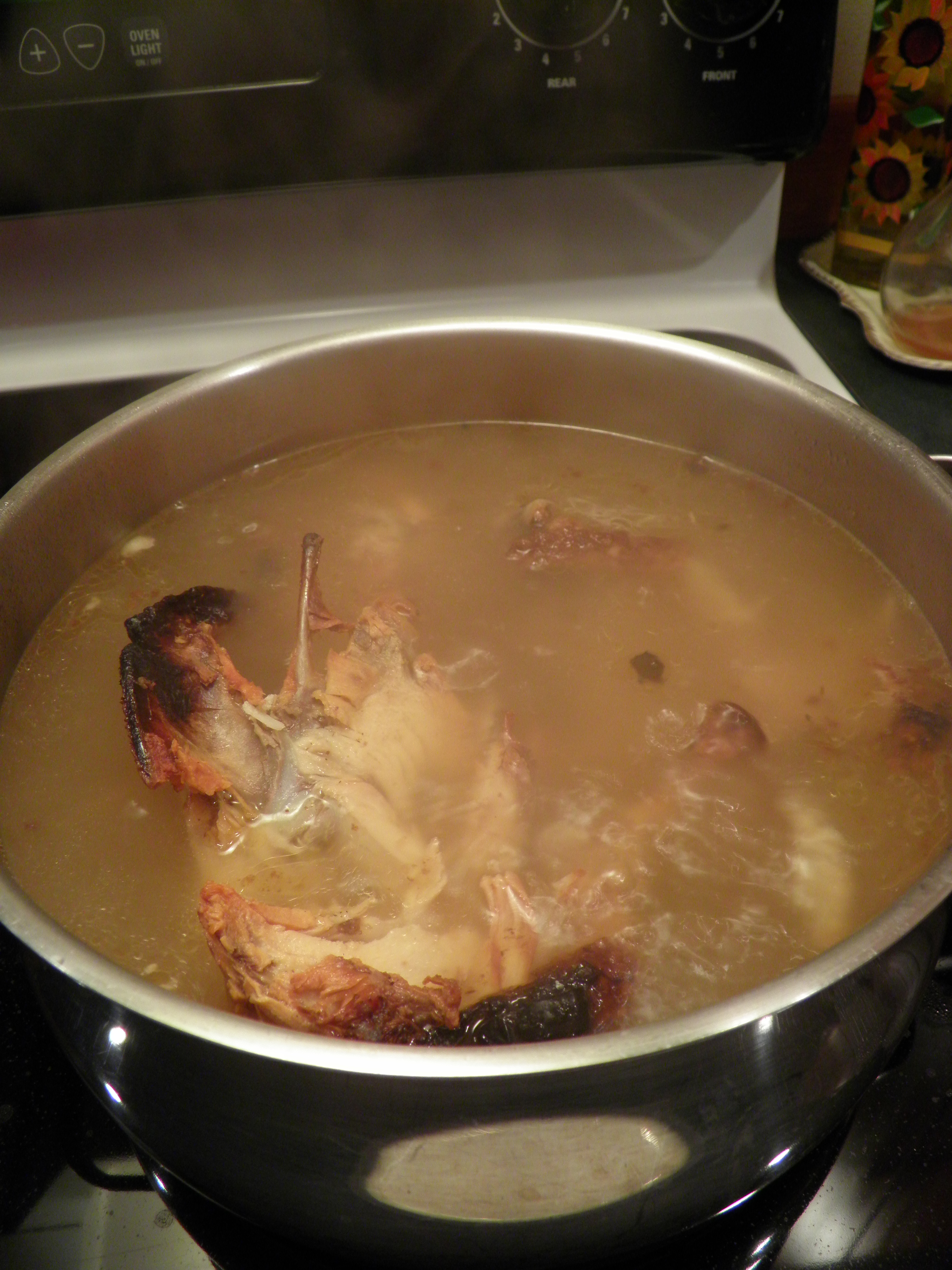
While the carcass is roasting, peel and cut four large carrots into bite-sized chunks or cubes.  Chop or slice four ribs of celery.  Chop one onion.  (You can add more of any vegetable if you like.  I often add more carrots because I love carrots in soups and stews.)  When the carcass is golden brown, remove it from the oven and place it in a large soup pot.  Add just enough water to cover the carcass and bring to a boil, reduce to a simmer, and cover with a tight-fitting lid.  You will immediately notice how rich the broth looks, much darker than broth from an unroasted carcass.  Color equals flavor!

OLYMPUS DIGITAL CAMERA

The carcass will need to cook about an hour to loosen all the meat from the bones and to release the flavor.  Drain the fat from the cookie sheet, and place carrots, celery, and onions on it, stirring to coat them in the leftover chicken fat.  Spread the vegetables out on the cookie sheet, sprinkle them with a little salt and pepper or the seasoning mix you used on the chicken/carcass, and return to the oven, roasting the vegetables until they also begin to take on some color.  You’ll be amazed at how much more flavor you get out of your vegetables by roasting them.  (You can also sauté them in a little olive oil or butter on the stovetop, but why dirty up another pan, and the oven is already hot!)

OLYMPUS DIGITAL CAMERA

When the vegetables are a little browned, remove them from the oven and scrape the cookie sheet to loosen any that have stuck to the pan.  Set them aside.  Do not add them to the soup pot until after you have removed the chicken carcass and bones from the pot.

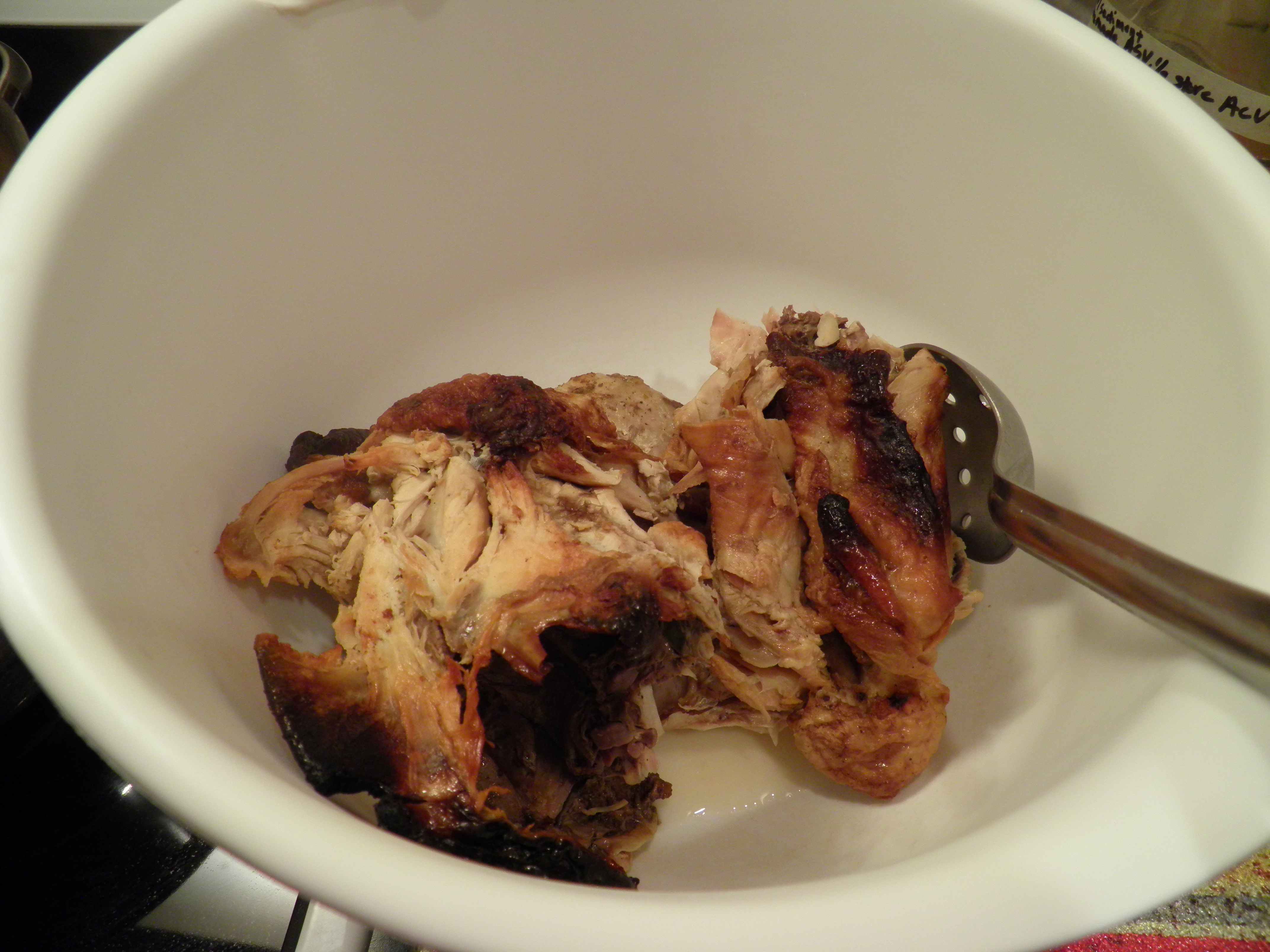
When the carcass is falling apart in the broth, it’s time to remove it.  Use a spider or slotted spoons to remove the carcass from the broth, and set it aside to cool.  While the carcass is cooling, you can add your roasted vegetables to the broth.  (I also rinse the cookie sheet with the broth, holding it over the soup pot and ladling the broth over it, to get off any little stuck bits of brown goodness, which adds flavor.)  This is the time to add the pan drippings you saved when you roasted your chicken, or any leftover gravy.  If you saved pan drippings, before you add them, be sure to remove the fat that rose to the top of the drippings as they cooled.  Your drippings should be mostly gelatinized.  That means flavor!  Taste the broth and adjust for seasoning.  Remember to use the same seasoning mix you used when you roasted the chicken as you season your broth.  This keeps competing flavors at a minimum.  When the carcass is cooled enough to handle, pick the remaining meat from the bones and add it back into the broth.

OLYMPUS DIGITAL CAMERA

At this point, your soup is essentially done, and you can serve it as is.  But there is much more you can do with it.  You can turn it into Everything But the Kitchen Sink or Clean Out the Fridge Roasted Chicken Soup.  Just start prospecting in your fridge and pantry.  To my last batch of soup, I added a couple of cubed potatoes, a cup or so of leftover green beans, about a cup and a half of leftover Seven Bean and Ham Soup (made with the leftover Christmas ham), and some Swiss chard I put in the freezer last year and rediscovered recently.  This produced a rich, hearty, soup-that-eats-like-a-meal.  One bowl of this contains all the meat and veggies you need for a complete meal, and if you are watching your weight, this soup is very figure-friendly.

OLYMPUS DIGITAL CAMERA

Of course, you can add noodles or rice, if you wish, but since I have been trying to eliminate grains from my diet, I usually add a can of rinsed, dark red kidney beans, or a can of black beans to my chicken soups in lieu of pasta.  This keeps the soup low-carb but hearty and full of protein.  I sometimes cook noodles or rice separately so that Dennis can put some in the bottom of his bowl and pour the soup over it.  That way, we both have what we want.  We will have several meals from a big pot of soup, and I’ve been known to freeze a quart for a snowy day.  I’ve found that soup is one of the best ways to stretch my food dollars and use leftovers that would otherwise be wasted.

Is soup-making work?  Yes.  Is it time-consuming?  Yes.  Is it worth it?  Yes, yes, yes.  Flavorful and nourishing:  it’s no wonder chicken soup has been known for years not just as comfort food, but as food for the soul.

Standard
Garden and Greenhouse

January Daze

The holidays have come and gone.  I’ve used up all the leftovers, and I’m sick and tired of cooking.  It’s the time of year when I’m glad I have a well-stocked pantry.  I can open a jar of abalone chowder base (just add half & half and sherry), or a jar of venison chili or venison stew, mix up a batch of cornbread, open a jar of pickles or dilly beans, and there’s dinner.

I tend to get a little blue in January.  After the holiday rush and bustle, the delight of having the whole family together, and the fun of watching the little ones enjoy the season, I always feel a little let down.  I remind myself that this is the time for rest.  Like my garden, I need this time to regenerate.  I need some quiet time to rest and think.  I need time for reflection.

When I was teaching, reflection was an important part of the way I taught writing as a process.  If we don’t take time to reflect on what we’ve done, we’re missing an opportunity for learning.  Rushing from one assignment to the next (whatever kinds of assignments these are, whether self-imposed or part of a standardized course) doesn’t give us time to understand what we’ve done well, where we need to improve, and what we need not do again.  Reflection allows us to make a solid plan for the future, based on what we know worked, or didn’t, in the past.

So this is the time when I pull out my garden log and go over the notes I made about the garden and the harvest during the spring, summer, and fall.  It’s the time when I decide what changes need to be made in what I plant and where I plant it.  It’s the time when I sort through my seed packets to see what I need to buy fresh and how much.  It’s a planning time, and it heartens me.

Seed catalogs have been arriving for a couple of months.  I put them aside until January, when their bright, colorful photographs cheer me and remind me that another growing season will fill me with energy, purpose, and hope.

I don’t buy a lot of seeds.  I sow very frugally because I hate to thin.  A packet of carrot seeds will usually last me two years because I don’t use them all the first year I open them.  The same with most small seeds:  beets, lettuce, spinach, etc.  I seal up the opened seed packets with masking tape, and I put all my unused seeds into an old plastic mayonnaise jar with a tight-fitting lid.  Into the jar along with the seeds, I place several silica packets, the kind that are shipped inside large bottles of medications, to absorb moisture.  I put this container in my laundry room, which stays cool summer and winter, and my seeds stay fresh for years.  I have some large packets of lettuce seeds that I’ve been planting from for ten years.

Seeds grown and processed for storage organically may be viable for a very long time.  There are reports of seeds left in Egyptian tombs for thousands of years that grew when planted.  Unfortunately, many large commercial seed companies began some years ago to treat seeds with substances that are supposed to increase germination rates and/or provide protection against pests and pathogens during and right after germination.  I believe these treatments affect seeds’ viability if they are not used within the first growing season after harvest.  For this reason, and the fact that I don’t like the idea of chemically-treated seed, I’ve begun to look for organic seeds and to grow more and more heirloom varieties and save the seeds myself.  Tomato seeds are very easy to harvest and save, and I’ve had very good luck with them.  I always germinate seeds like tomatoes, peppers, and eggplant between moist paper towels stuffed inside plastic zipper bags.  It only takes a couple of days, and that way, I know exactly how many plants I will get from those seeds.  When the sprouts have just broken the seed coat, I can use tweezers to gently move them from the paper towels into warm, damp seed-starting medium and put them under a grow light in the greenhouse.

For other plants like lettuce and spinach, I allow self-sowing.  I let these plants flower (which has an added benefit of giving the bees more blossoms to milk). This means the garden gets pretty raggedy-looking in July and August, when the plants bolt and send up tall spikes of unremarkable flowers, then turn brown and, well, seedy-looking, but it saves me time and work and energy, and I get lettuce and spinach earlier the following spring.  There’s no guesswork on my part about when to plant:  the self-sown seeds sprout when conditions are favorable.  The plants and seeds do all the work.  Sometimes the seeds sprout where I didn’t expect them to, but I just work around them.  I like the spontaneity of allowing self-sowing.  I don’t mind a head of romaine in the middle of the row of carrots.

Larger seeds like pumpkins and squash are also viable for years when left untreated.  I have a pumpkin seed story that makes me smile every time I think of it.  When my children were small, I always grew jack-o’- pumpkins for them.  I usually grew a medium-sized variety, and we’d cook the pumpkins down the day after Halloween for pumpkin pies.  But one year when they were a little older, they wanted big pumpkins, so I planted a variety called Big Max.  They were big, all right.  We don’t have a very long growing season here, but we got a few Big Maxes, and I grew them for the kids for several years before I stopped growing a garden under the pressures of completing my M.A.

When my grandchildren were old enough to enjoy the idea of growing their own jack-o’-lanterns, I dug out the few leftover Big Max seeds and planted them.  Those seeds were twenty years old, at least, maybe older, and I got about a 50% germination rate from them.  Kaedynce and Bryce grew four big carving pumpkins from two plants.  I had stored the seeds using the method above, with silica packets in my leftover seed jar.  That was several years ago, but the kids still talk about Big Max and Maxine.  Yes, they named their jack- o’-lantern pumpkins!

Despite (or perhaps because of) this experience with the pumpkin seeds, I know that as my seeds get older, their viability will begin to decrease.  This is natural.  So I always plant a few extra seeds, more than I would if the seed was fresh.  This spring, because of my garden log, I know that while I still have a few Minnesota Midget cantaloupe seeds left (the only melons that do well in my garden), they will be five years old this spring, and I only got about 50% germination out of them last year.  I need fresh seed.  They are a hybrid, so I can’t save the seed myself.  But I’ll still soak the old ones and sprout them between paper towels, so I can use up every last seed that’s viable.  I don’t like to waste a thing if I can help it.

Just thinking about spring planting cheers me up.  On this gray day, when we’re in the middle of another drought cycle, and yet another moisture-bearing storm is pushing north of us, leaving only dry clouds to veil the winter sun, it’s good to rest, reflect, and plan.  That’s what January is for, in my book.

Standard
condiment, Main dishes, Recipes

Dried Tomato Skin Rub and Pulled Pork

OLYMPUS DIGITAL CAMERA

I have about a pint of powdered dried tomato skins, a by-product of canning tomatoes this summer.   I know some people thought I was nuts for saving, drying, and grinding the skins you have to peel off the tomatoes for salsa, sauce, and canned tomatoes.  But I have learned that these dried tomato skins pack quite a flavor punch.  I’ve been using them in chip dips, soups, and sauces.  Now, I’ve added them to a homemade pork rub which produced beautifully-seasoned pulled pork cooked in the crock pot.   Of course, the rub is still very good without the tomato skins.  Why wouldn’t it be with all that wonderful spice!

Pork Rub (with Dried Tomato Skins)

1 tablespoon dried tomato skin powder

1 tablespoon brown sugar

1 tablespoon kosher or coarsely-ground sea salt

¼ teaspoon cayenne pepper (see note below)

2 teaspoons hot smoked paprika (see note below)

½ teaspoon ground cumin

¼ teaspoon ground cinnamon

½ teaspoon garlic powder

Mix well and rub on dry meat.  This rub would be good on spare ribs or chicken, as well as the pulled pork recipe below.

OLYMPUS DIGITAL CAMERA

Easy Pulled Pork

4-5 lb. pork shoulder, pork tenderloin, or pork loin roast (see note below)

1 onion, chopped

4 cloves of garlic, chopped

a few drops of liquid smoke (optional)

2 cups chicken stock

Rub all sides of pork with seasoning mix (above).  At this point, you can rest the pork in the fridge for up to 12 hours to get the most flavor out of the rub.  Or, you can start cooking it right away in the crock pot.  Because this big hunk of meat takes so long to cook in the crock pot (8-12 hours), the rub gets into the meat nicely during cooking.  When you are ready to cook your pork, proceed as follows.

OLYMPUS DIGITAL CAMERA

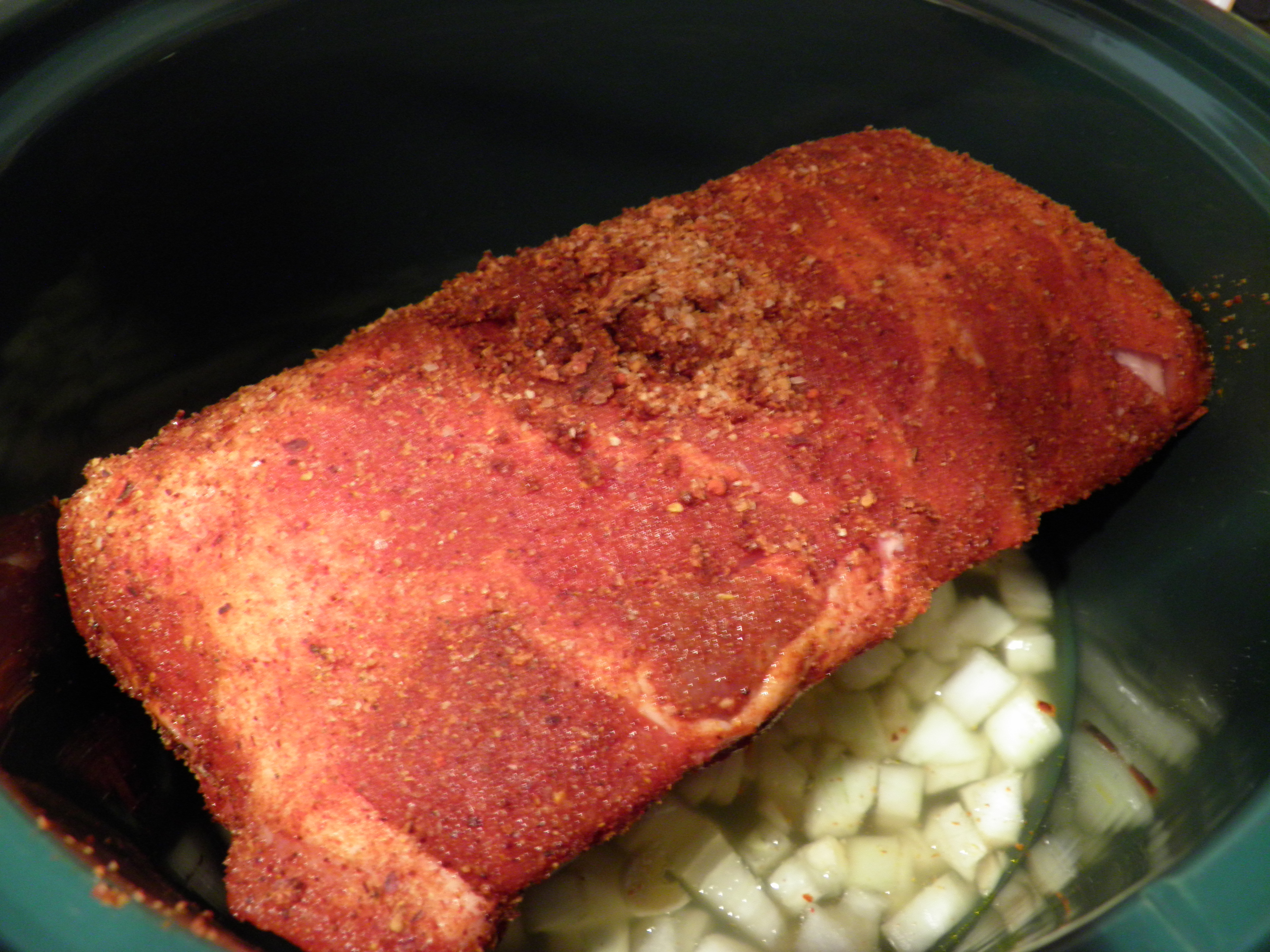
Place onion and garlic in bottom of large crock pot, pour in chicken stock, add a few drops of liquid smoke if desired (be cautious, it’s strong) and place rubbed pork on top.  Cover and cook on high for about 8 hours; on low it may take up to 12 hours.  Cook until the meat is falling off the bone or shreds easily with a fork .  Remove meat from crock pot.  Rest, covered loosely with foil, until steam is no longer rising from meat.  While meat is resting, make sauce.

Barbecue Sauce

Pour the liquid, onions, and garlic from the crock pot into a medium-sized sauce pan.  Add 1 cup of ketchup or 1 ½-2 cups of tomato sauce, 1/3 cup of molasses or 1/4 cup of brown sugar (adjust sweetness to your taste), 1 tablespoon of Worchestershire sauce, 1 tablespoon of apple cider vinegar, and bring to boil over high heat.  Lower heat to produce medium boil and reduce sauce until it reaches desired consistency, stirring frequently to prevent sticking.  It should thicken to a gravy-like consistency but not be too thick to pour.

Pull rested meat into shreds with two forks.  Pour sauce over meat or serve sauce on the side.

Notes:  I have listed cayenne pepper here, but of course, if you are heat-sensitive, you can omit it or use less.  I actually didn’t use cayenne.  I used a hot pepper mix that Theresa, my son-in-law’s mother, gave me.  She buys two varieties of very hot peppers in the market in Kaduna, Nigeria, boils them, dries them in the sun, and grinds them to powder.  She gave me a half-pint of this stuff, and I love it.  It is very hot, hotter than cayenne, but very flavorful.  I intend to try her technique with my habaneros I’ve been ripening on the cut bush in the laundry room.

Also, I listed hot smoked paprika, which I just discovered in bulk at the WinCo store in Reno.  I’ve heard about it for years, but it isn’t easy to find, and it normally isn’t cheap.  It’s quite affordable at WinCo.  I love the flavor it gives, but you could easily substitute plain paprika and add just a drop more of liquid smoke, if you wish.

You can make pulled pork with boneless pork tenderloin or loin roasts, but the best cut of pork for this dish is a pork shoulder roast (also known as butt).  Bone-in is best because the meat has more flavor when cooked on the bone.  The long, slow cooking time tenderizes this tougher cut of meat and allows the fat to cook all the way out, producing a tender, flavorful, and juicy dish.  This dish can also be cooked in a large Dutch oven or turkey roaster with a tight-fitting lid.  Bake at 325 degrees until meat is tender and pulls apart with a fork.  It will take slightly less cooking time in the oven, so keep checking for desired tenderness.

The rub mix gets into the liquid in the crock pot as the meat cooks, so there is no need to add more salt or pepper to the sauce when you use the cooking liquid as the base of your sauce, unless you are a salt fiend.  This produces a medium-hot barbecue sauce.

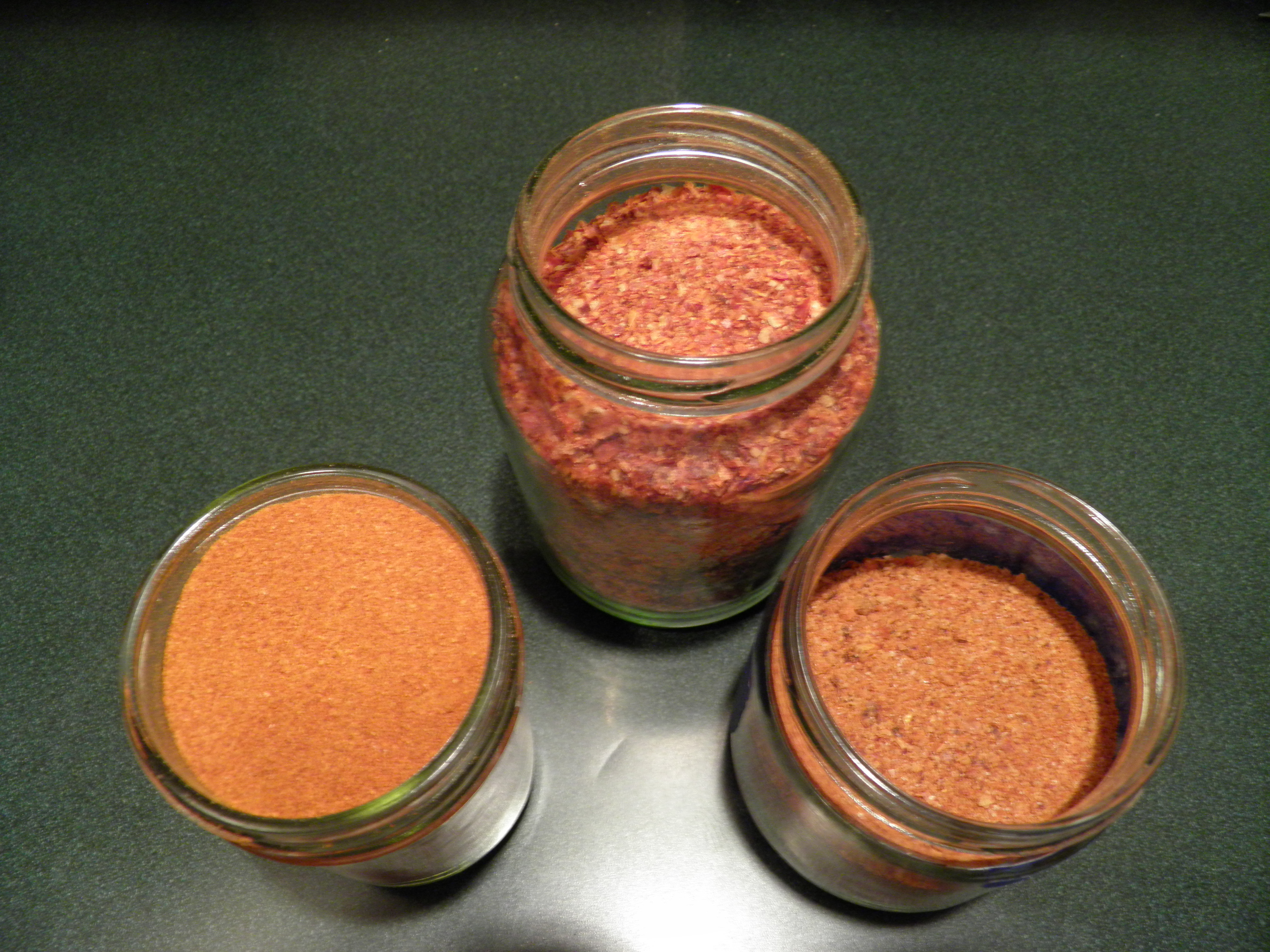
OLYMPUS DIGITAL CAMERA Nigerian pepper mix on left, tomato skins in center, finished rub on right.

We enjoyed this dish so much the other night, I’m planning to cook it again on New Year’s Eve for the family get-together.   I normally take pictures of the finished food, but after smelling this pork cooking all day, we just couldn’t wait to dive into it.  I served the pulled pork and sauce with sourdough rolls, baked beans, and coleslaw, but on this New Year’s Eve, we are having a feast of Nigerian food, prepared by my son-in-law, Solomon, and his mother, Theresa, with help from Amy and me.  I think the pork will go well with the Nigerian dishes, and hopefully, I’ll have some Nigerian recipes to share with you all at a later date.  Happy New Year, everybody.

Standard
Fermenting

Science Experiment: Homemade Ginger Ale

Update:  December 21, 2014

I’ve updated again!  For making, feeding, storing, and maintaining your ginger bug, scroll down.  For the best ginger ale recipe and fermentation method, please click on Ginger Ale Update.

Update: February 21, 2014

I’ve been experimenting with the ratios and mixtures and fermenting times, and so far, my best result has been with my Sweeter Ginger Ale recipe given below.  I made some more with this mix this week, with only one alteration (I used only 2 tablespoons of fresh ginger in the hot mix with the sugar and water), and I ended up with the best batch ever.  I fermented it for 3 days by the heater, so it was nice and warm, and then when I had lots of small bubbles for a day and big bubbles for two days, I put it into the fridge without opening the jug.  I was using the glass gallon juice jug in the pictures below.  That seems to be the ideal container.  I chilled the jug in the fridge for a day before opening it, and I had so much carbonation when I opened it the next day, it sounded like a bottle of store-bought soda that had been shaken and then opened.  It didn’t spew, though!  I strained off a glass, and it had so much carbonation, it sat there and fizzed in the glass like a store-bought soda.  The flavor was delicious, gingery but not overwhelmingly so like some previous batches have been.  I’m so pleased with the recipe now, I wanted to share my update with you all.

I should also mention that I’ve been experimenting with how the ginger bug reacts after being stored in the fridge.  I’ve gone ten days between feedings, and my bug still seems healthy.  I always take it out and let it warm up for a few hours before I feed it, then let it sit overnight to work before I stash it in the fridge.  I have also noticed that it does just fine when I feed it only a tablespoon of raw sugar with a tablespoon of water occasionally if I am building up the volume of my bug before making a batch of ginger ale.  I did this when I was running low on ginger, and since it looked like there was plenty of ginger in the jar, I figured all the bug probably needed was a little sugar to feed the yeasts.  That seems to be the case.  I will continue to do this, feeding my bug every other time with just raw sugar and water, because I find that it becomes a little too strong with ginger otherwise.  End of update!  Original post (with Sweeter Ginger Ale recipe below) follows.

Original post:

As some of you know, I’ve been learning more about fermenting and culturing foods lately.  I’ve made yogurt and apple scrap vinegar for years.  Now, I’ve moved on to homemade ginger ale.  And it’s pretty darn good.  Dennis liked it, and while he’ll eat anything, he’s a bit picky about beverages, so his is an important endorsement.

I followed another blogger’s process (Wellness Mama), but I, and others, found the written directions somewhat confusing.  It was necessary to scroll through all the comments and read the contributions of followers to figure it all out, so I’ve decided to write the process down myself, using what I’ve learned about fermenting other foods, and hopefully making it clearer for myself and for a few other folks who want to try making their own fermented beverages.

Now, why make your own ginger ale rather than buying it?  For one thing, you won’t be getting any high fructose corn syrup in your homemade ginger ale.  You can sweeten it with whatever you like if it’s not sweet enough for you as is.  Secondly, because it is naturally fermented and carbonated, it contains some probiotic material that is good for your gut.  And finally, it contains real ginger, which has long been known as a healing agent, particularly good for stomach troubles.  And, I would add, it’s kind of fun to make.  Well, if you’re into food-related science experiments like me.

This is a two-step process.  First you have to make what’s known as a ginger “bug.”  I assume it’s called a bug because it is actually alive.  (Mmwha-ha-ha-ha . . . translation:  evil laugh.)   All the bug is, really, is an environment to keep the beneficial bacteria responsible for fermentation alive and well.  After you have the bug going, and it’s thriving, you’re ready to make ginger ale, another step in fermentation that produces the bubble and fizz of carbonation.  Oooh, fun stuff.

You need some containers, one for the bug, and one for the ginger ale.  For the bug, a quart glass jar is fine.  You need some nylon tulle, some breathable fabric, or a coffee filter (just as if you were making vinegar) and a big rubber band off a bunch of broccoli to hold your breathable fabric or coffee filter on the mouth of your jar.  For the ginger ale, you need a bigger jar.  Contrary to the original instructions from Wellness Mama, a half-gallon jar will not work.  The liquids add up to more than two quarts.  If you have a gallon-sized glass juice jug, or something between a half-gallon and a gallon, that will work.  You need a jar or jug with a tight-fitting lid to capture the fizz.

Ginger Bug

In your clean quart jar, combine:

2 cups of water

2 tablespoons of grated or chopped fresh ginger root (peeled if not organic)

2 tablespoons of sugar

You can use whatever sugar you have on hand.  I used raw sugar, and it worked very well, but others say you can use white table sugar; some recommend adding a teaspoon of molasses for color, flavor, and minerals if white sugar is used.  Sugar feeds the organisms on the raw ginger that create fermentation.

A word on water.  Some folks use filtered or bottled distilled water, and I would do this if I had chlorine in my water.  I have hard well water, and it worked just fine.

Cover your quart jar with the breathable material, secure it, and place it somewhere warm. My kitchen was cold when I started the bug, so I kept it near the heating stove, where it stayed about 78 degrees.  A warm, not hot, temperature encourages the growth of yeasts, etc. in your ginger bug.  If it’s cold, you’re more likely to get mold than fermentation, and you’ll have to throw it out and start over if you get mold.  Mold does not taste good.  This is what it looks like when you have the bug going.

OLYMPUS DIGITAL CAMERA

Now, every day for five days, add 1-2 tablespoons of grated or minced ginger root, 1-2 tablespoons of sugar, and 1-2 tablespoons of water to your bug, stirring well.  Some folks say you shouldn’t use a metal spoon, but this is just silly because you use a metal knife or food processor to chop the ginger.  Stirring with a metal spoon isn’t going to harm your bug, but if you are worried about it, by all means, use a wooden or plastic spoon.  (I wouldn’t use a silver or iron spoon, but who uses spoons like that to stir things like this anyway?)  The thing to remember is to use the same proportion of ginger to sugar to water each day.  Cover the bug, put it back in its cozy spot, and go on about your business.  In a day or two, you should start to see some foaming or bubbling, maybe hear a little hissing, see a little fizzing when you stir the bug.  That means your bug is fermenting, and all those little organisms (bugs) are growing.  Yay!  After five days of this, you are ready to make ginger ale.  (When you have used some of your ginger bug for ginger ale making, you need to add back ¼ cup of water, 2 tablespoons of sugar, and 2 tablespoons of fresh chopped ginger to the bug before storing it.)

But first, it is important not to let your ginger bug sit at room temperature more than about 5 days after it starts to ferment, because it could start to turn to vinegar (move from alcoholic fermentation to acetic fermentation) after that time.  If you want to hold your bug at readiness and not make ginger ale right away, you can put a tight lid on the jar and stash it in the fridge indefinitely, as long as you take it out and feed it once a week.

To feed your ginger bug, bring it out of the fridge, bring it to room temperature, add a tablespoon of minced/grated ginger, a tablespoon of sugar, and a tablespoon of water.  Let it sit out at least 8 hours in its cozy place, then it can be refrigerated again.  If you are using your ginger bug after resting in the fridge, take it out 8 hours before you want to use it to make ginger ale, feed it, and let it sit and get warm and active before adding it to the ginger ale ingredients.  Now, here are the directions for making ginger ale.

Homemade Ginger Ale

In a large sauce pan, heat:

2 tablespoons of grated or minced fresh ginger root (peeled if desired or if not organic)

½ cup sugar (raw/demerara, organic, or if white sugar is used, add 1 tablespoon molasses as well)

½ teaspoon sea salt (kosher salt is fine, and I don’t imagine that plain table salt would adversely affect the ginger ale)

3 cups of water (filtered or distilled if you have chlorinated water or if you think the mineral content of your water would produce a nasty taste)

Simmer for about 5 min. to dissolve sugar and infuse the water with the ginger.

Add:

5 cups of cool, filtered water (if filtering is necessary)

½ cup fresh lemon or lime juice or combination thereof

½ cup ginger bug

Make sure the water/sugar/ginger mixture is cool before adding ginger bug.  (You don’t want to cook the bugs!)  Mix well.  Pour into large jug and cap tightly.  (Again, a half-gallon jar will not work.  With 8 cups of water, ½ cup of juice, ½ cup of ginger bug, you have at least 9 cups of liquid, and that won’t fit in a half-gallon jar.)

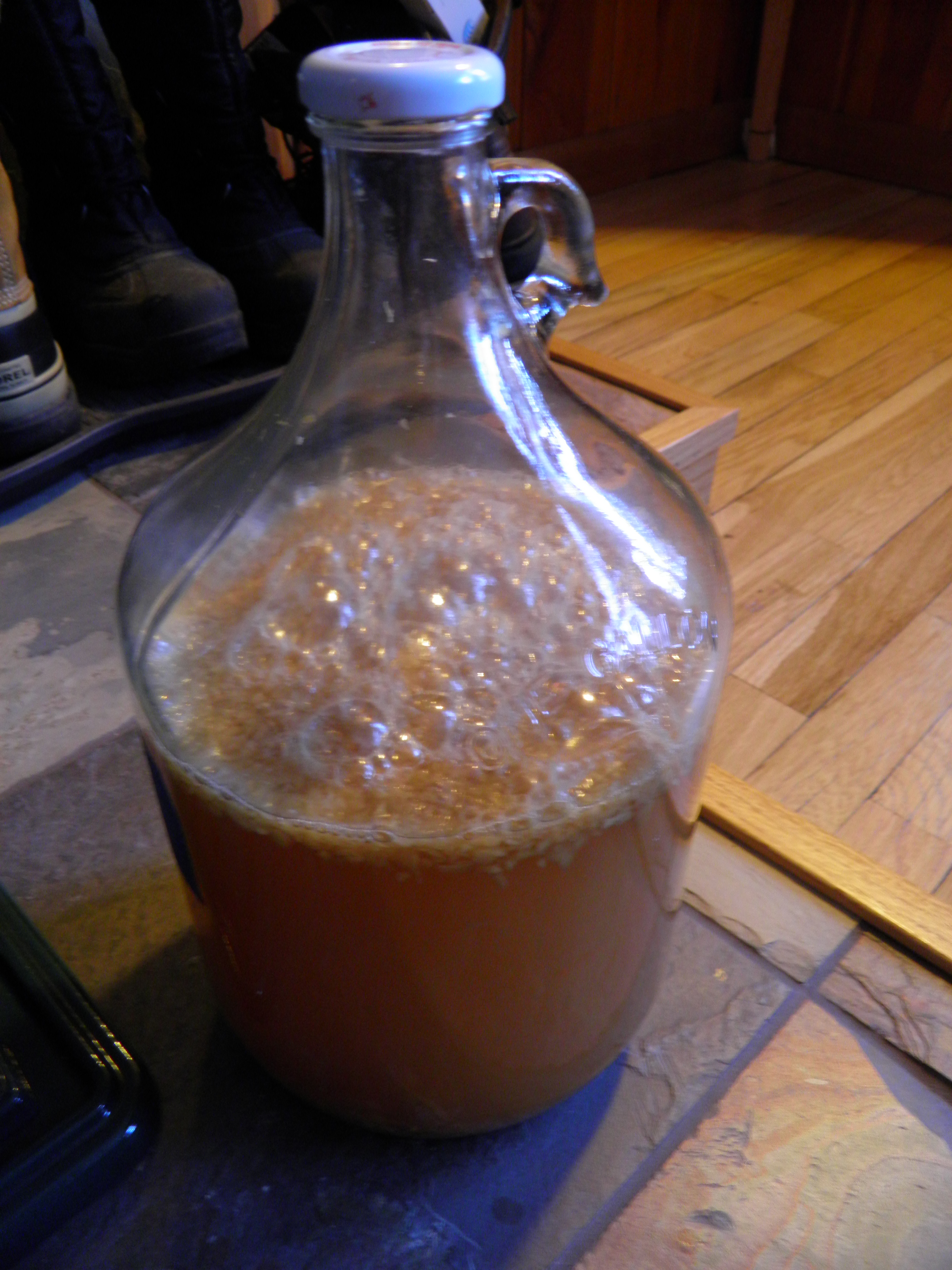
Put this tightly capped jug in the warm, cozy place, and let it sit.  If your ginger bug has fermented properly and is active, the ginger ale should begin to bubble within a few hours.  Here’s what mine looked like (my second batch).

OLYMPUS DIGITAL CAMERA

Let it sit until bubbles just begin to diminish.  At this point, it’s ready to drink.  Chill the jug well before opening.

Now, here’s what’s going to happen when you open the lid on your ginger ale.  Just as with commercial sodas, there will be a loss of carbonation as soon as you open the jug.  I got a big hiss of escaping gas when I opened the lid on my gallon juice jug.  I tried to tighten it back down, but the gas kept escaping.  For this reason, it’s best not to open your ginger ale until you are ready to drink it, and then to pour it quickly through a strainer (so you aren’t chewing little bits of ginger, but save the ginger because you can use it in your next batch of ale) into glasses loaded with ice and whatever else, if anything, you want to put in the ginger ale (various kinds of alcohol spring immediately to mind) and drink it up right away.  If there is any left over, pour it off straight away into a smaller bottle and cap tightly.  It will not be as fizzy when you open it, but it will still taste good.  Here’s what my first batch looked like after I strained it off out of the big gallon juice jug.  (I saved the ginger and put it in the second batch with some additional fresh ginger to feed the fermentation.)

OLYMPUS DIGITAL CAMERA

It should be stored in the fridge, where it will keep indefinitely.  If stored at room temperature, it will eventually become alcoholic.  (Yeasts + sugar + time = booze.)

I should say a few words here about sweetness.  This stuff is not sweet.  It was not sweet enough for my son and husband until I stirred about a teaspoon of raw sugar into it.  It was sweet enough for me as is, and very refreshing.  But when I wanted something a little sweeter, I stirred about a half teaspoon of raw sugar into mine.  I also tried it with a little Splenda, which I use very sparingly these days, and it was quite good.

Because I wanted to see if I could produce a batch that would be sweet enough out of the jug for the family, I altered the recipe a bit.  Wellness Mama’s instructions add that you can adjust the volume of the recipe by using a ratio of ¼ cup sugar per 1 quart of water and adding ¼ cup ginger bug for each quart of water used.  I followed these directions for increasing the volume of my second batch but doubled the sugar and kept the amount of lemon/lime juice the same, since the first batch was very acidic.

Sweeter Ginger Ale

Simmer for 5 minutes:

1 quart water

4 tablespoons minced ginger

1 cup raw sugar

1 teaspoon sea salt

Add:

2 qts. cool water

½ cup lemon or lime juice (I used about ¼ cup lemon and ¼ lime juice)

¾ cup ginger bug

Mix well and pour off into gallon jug; cap tightly.  Let sit in warm place for 2-3 days.  Chill and strain before drinking.

I should note that this mixture bubbled up very quickly, producing a lot of carbon dioxide the very first day, but was not as fizzy as my first batch when the jug was opened.

OLYMPUS DIGITAL CAMERA

Given my experience with making vinegar (which also ferments), I believe it was the added sugar in this mix that caused a faster fermentation.  I also think that for great fizz, the mixture should have been drunk immediately, rather than chilled and stored for two days, as I did.  It’s also possible that the cap on my jug released carbonation.  I am using a glass gallon-sized apple juice jug with a metal, screw-on lid.  A bottle with a bail closure and rubber seal on the stopper might work better to contain the carbon dioxide.

These ratios produced a slightly sweeter ginger ale that no one needed to add sugar to, and everybody liked.  My son-in-law, who was born and raised in Nigeria, says he grew up drinking something very similar.  He was particularly appreciative of my homemade ginger ale and wants me to make it again for New Year’s Eve, when his mother and nephews will be visiting with us.

Wellness Mama cautions against over-fermentation to prevent the bottle from exploding.  Frankly, I think this is highly unlikely unless the bottle was made of very, very thin glass and the lid were truly air-tight.  This stuff would be more likely to blow the lid off.  However, I also think that if a jug is going to blow its lid, it’ll be because it doesn’t hold enough space for the gas.  When that space is full and gas is still being produced, it has to exhaust somehow.

I liked my first batch of ginger ale made following Wellness Mama’s directions, but we all liked the second batch best, made with more sugar and less lemon/lime juice.  I think it would be fine to eliminate the citrus juice altogether, and just add a twist of lemon or lime to the glass before drinking.

For my next batch, I think I’ll start with the original instructions, double the sugar, reduce the water by one cup, eliminate the citrus, and see if it will almost fill but not overflow a half gallon jar.  I’m curious to see if I will get more fizz from an almost full jar when it is opened.

At any rate, I’ll have fresh, homemade ginger ale for Christmas Day and New Year’s Day.  How fun is that?  For this nutcase food nerd/amateur scientist, it’s pretty darn fun.


Standard
Desserts, Recipes

Christmas Cookies

This week’s post is a Christmas cookie story.  But more than that, it’s a story about families, and it’s the story of traditions.  Hang with me, and there will be some recipes in it for you.

Christmas means, among other things, Christmas cookies.  For our family, there are two kinds of Christmas cookies: gingerbread and sugar cookies.  These are two old-fashioned cookies whose goodness, for me, never goes out of style.

I usually make crisp gingerbread cookies to hang on the tree.  They smell good, taste great dipped in coffee like biscotti, and because there is no butter or egg in them, they keep until well after the tree comes down, if there are any left.  After the cookies are rolled, cut, and on the cookie sheet, I poke a hole in the top of each cookie with a straw, so it can be threaded with a ribbon and hung on the tree.  These cookies will perfume the room with spice and give an old-fashioned look to our tree.  For the tree, I don’t decorate them, because I don’t want bits of icing or sprinkles falling on the floor, and besides, I like the way they look, plain, among the brightly-colored ornaments.

OLYMPUS DIGITAL CAMERA

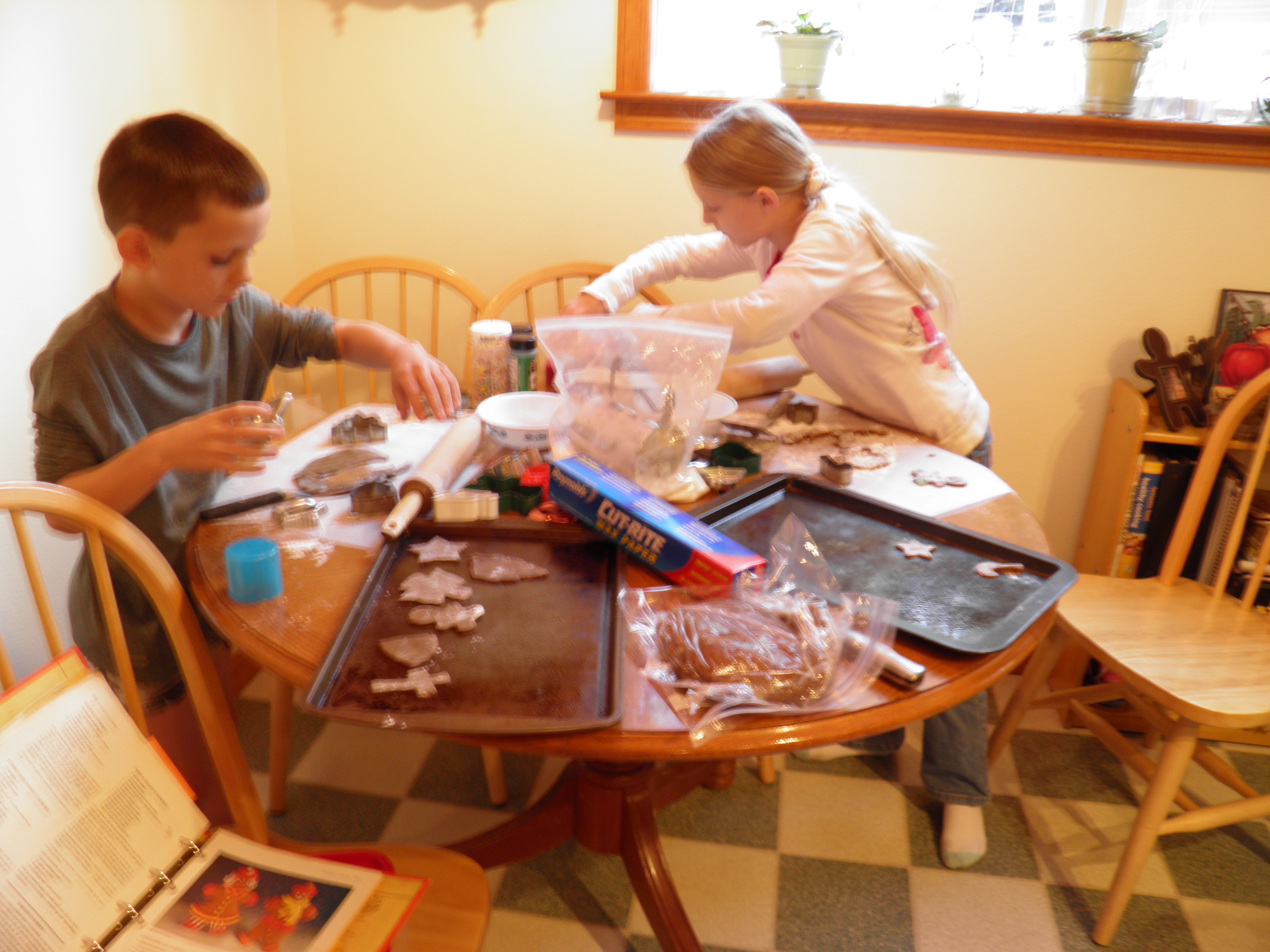
If I want to give them away or put them in the cookie jar, I’ll let the kids ice them or sprinkle them with colored sugars or candy sprinkles.  It turns out that my son-in-law, Solomon, loves spicy gingerbread, so the grandkids and I made them especially for him this Christmas.

OLYMPUS DIGITAL CAMERA      OLYMPUS DIGITAL CAMERA   OLYMPUS DIGITAL CAMERA

Gingerbread Cookie Ornaments

(makes about 4-5 dozen medium-sized cookies)

¾ cup dark molasses

½ cup packed dark brown sugar

1/3 cup cold water

5 tablespoons shortening

3 ½ cups flour (all-purpose or whole wheat pastry flour can be used)

1 teaspoon baking soda

½ teaspoon salt

½ teaspoon ground allspice

1 teaspoon ground ginger

½ teaspoon ground cloves

½ teaspoon ground cinnamon

Beat molasses, sugar, water, and shortening.  Mix in remaining ingredients.  Dough will be relatively stiff.  Cover with plastic wrap and chill for at least 2 hours to firm dough.

Heat oven to 350 degrees.  Roll dough ¼ in. thick on floured board (do not use whole wheat flour for rolling).  Brush off excess flour and cut with floured cookie cutters into desired shapes.  Place about 2 inches apart on lightly greased cookie sheet.  For tree ornaments, use a plastic straw to cut out little holes in tops of cookies.  If you are decorating with colored sugar or sprinkles, shake these over the cookies and press lightly into dough.

OLYMPUS DIGITAL CAMERA

Bake until firm, when no indentation remains when touched, about 10-12 minutes.  Cool on rack before frosting, if desired.  (I don’t recommend frosting before hanging on the tree, for reasons mentioned above, but that’s up to you.)

OLYMPUS DIGITAL CAMERA

I am not a professional baker, nor a photographer, just a pretty good cook.  So I don’t claim these are the prettiest cookies you’ll ever see.  But they sure taste good!  (My daughter-in-law, Tori, says that I make things taste good, and she makes them look good, and that’s the truth of it.)

OLYMPUS DIGITAL CAMERA

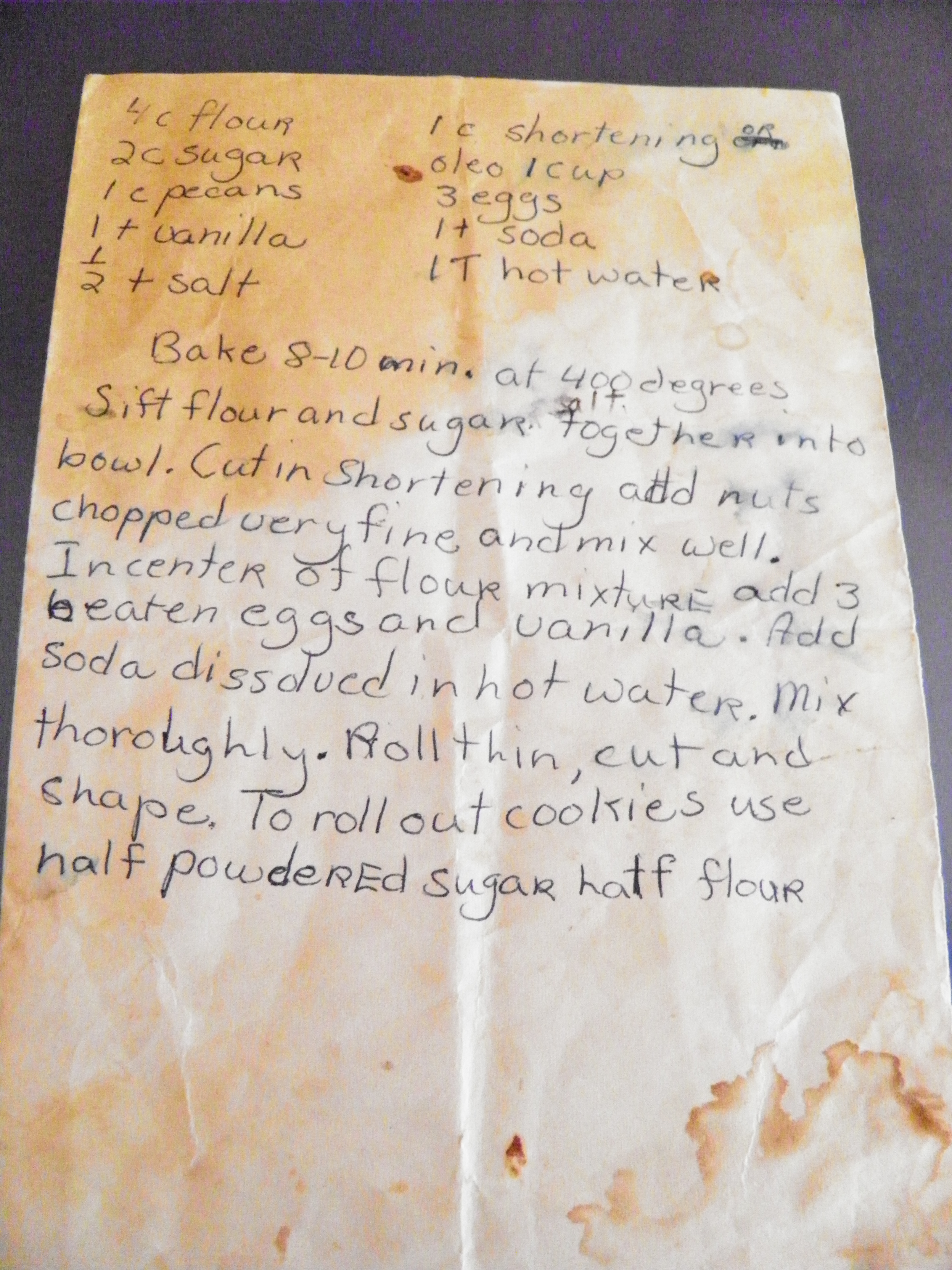
The other cookie we always make is a sugar cookie.  This recipe comes from a neighbor and good friend of my mother’s, Marge Darby.  My brother and sister and I played with and went to school with the Darby kids, so their family is always there in my memory whenever I think about my childhood.   My mother loved these cookies, and one day, she sent me over to the Darby house to copy down the recipe.  I must have been 8 or 10 years old, as my awkward printing in the original copy attests.

OLYMPUS DIGITAL CAMERA

Since I wrote this recipe down nearly 50 years ago, it’s the one always used in our family.  I have tried others, but they just don’t stack up to this one.  Both Marge and Mama have since passed away, but I think of them each time I bake these cookies.

About a year or so ago, the oldest Darby boy, Tom, contacted me via Facebook.  We’ve been sharing memories and stories ever since, so when I got the sugar cookie recipe out in preparation for this holiday season, I thought I’d take a picture of it to show to Tommy.  I was sure he’d get a kick out of it, but I had no idea it would mean as much to him as it did.  (For his reaction, see Tom Darby’s blog.) Just this past week, he baked the cookies he remembered from childhood.  And he gave us a little more of the recipe’s history. Tommy says, “As far as I can recall they came from my Grandma on my Dad’s side. They were in a cookbook put together by the Women of the Fort Dodge (Iowa) Lutheran Church which was published sometime between the end of the Great Depression and World War II.”  That’s a recipe with a lot of history and tradition behind it, and they are the best sugar cookies I’ve ever tasted.

Sugar Cookies

4 cups flour

2 cups sugar

1 cup finely chopped pecans

1 teaspoon vanilla

½ teaspoon salt

1 cup shortening, or butter, or *oleo  (see note below)

3 eggs

1 teaspoon baking soda

1 tablespoon hot water

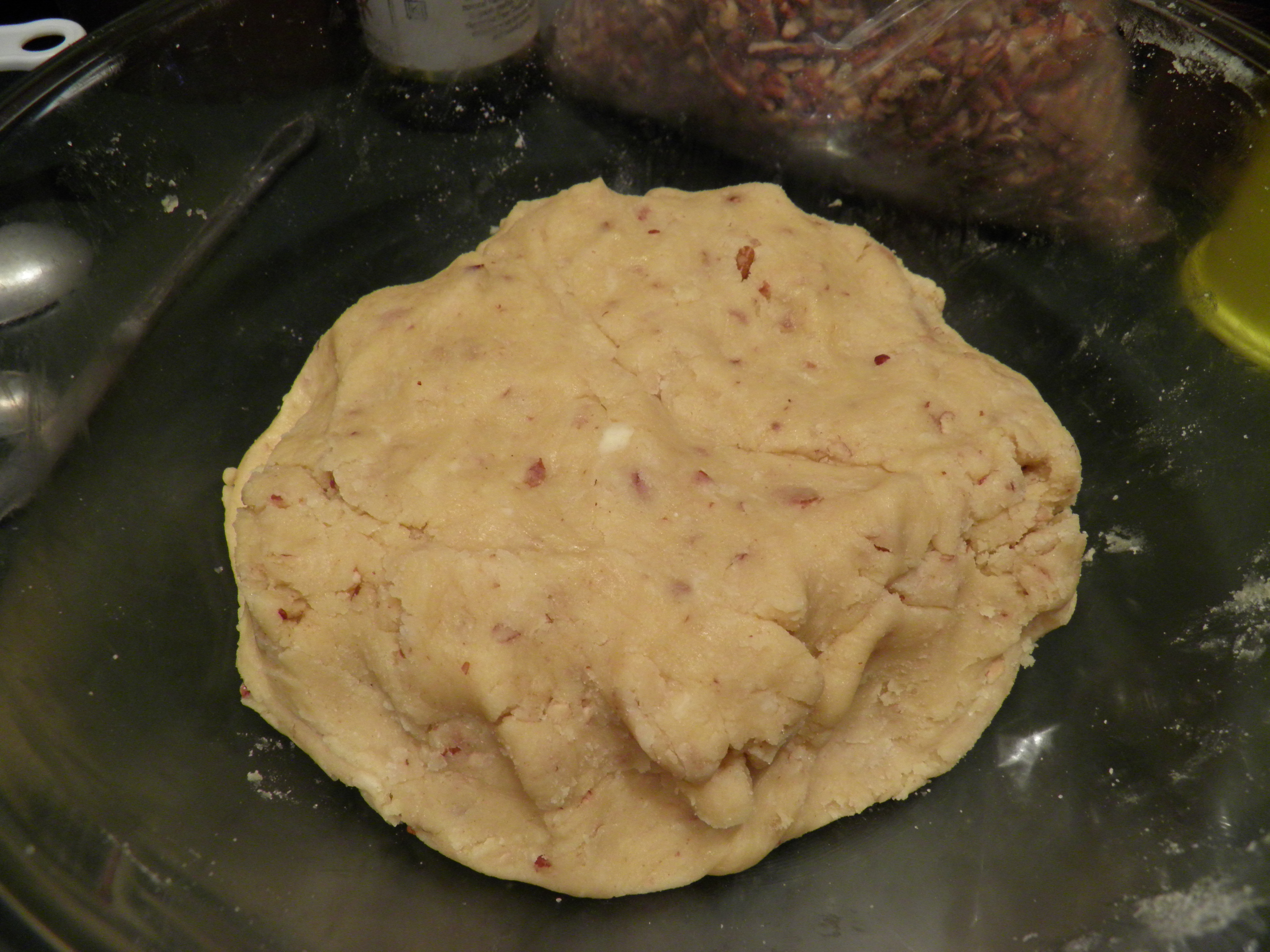
Sift flour and sugar and salt together into bowl.  Cut in fat, add nuts and mix well.  In center of flour mixture add 3 beaten eggs and vanilla.  Add soda dissolved in hot water.  Mix thoroughly.  Roll thin, cut and shape.  To roll out cookies, use half powdered sugar, half flour.  Place two inches apart on ungreased cookie sheet.  Bake 8-10 minutes at 400 degrees.

OLYMPUS DIGITAL CAMERA

Notes:  For those who don’t know, oleo refers to oleomargarine. It became popular or widely-used during the food rationing of WWII. A friend of mine remembers mixing the yellow coloring into the margarine to make it look like butter. I grew up using margarine for everything, but of course I don’t use it any more. However, for this recipe, I usually use half shortening and half softened butter.  I like the flavor butter gives, but all butter makes the cookies spread awkwardly and lose their shapes.

I always chill the dough for an hour before rolling—this makes them easier to roll, and it also helps them keep their shape while baking.  Keep the dough in the fridge and cut off smaller pieces to work with until it is all rolled and cut.  Thin means about 1/8th inch, and this thinness helps keep them crisp, but you have to watch them because they will burn quickly.

Also, using half powdered sugar and half flour to roll out the cookies is key.  Plain flour (as I learned through bitter experience) just doesn’t taste as good.  I often use whole wheat pastry flour in the cookie dough, but it should be noted that to roll out the cookies, you need to use white, all-purpose flour mixed with the powdered sugar.

This recipe makes a lot of cookies, about 6 dozen, depending on what size you make them.  I often cut the recipe in half.

I used to decorate these cookies with a standard powdered sugar icing, but then I discovered edible paint, and that was what my children liked to do, and now my grandchildren enjoy painting the cookies as well.  (Some years, they get really creative.  This year, we baked between 10 and 15 dozen cookies, so they kept it basic!) I keep a set of cheap paintbrushes in the kitchen for this purpose and just run them through the dishwasher when we are done.

Edible Paint:

Separate two eggs.  Beat the yolks with a fork, then add 1 teaspoon of water and mix well.  Divide into several cups or dishes.  Add different food colorings to each cup, mix well.  After the cookies are rolled out, cut, and on the cookie sheets, use clean paintbrushes (run them through the dishwasher if they’ve been previously used on watercolor paints) and egg yolk paint to color the tops of the cookies.  As they bake, the paint will harden into a glaze.  They are really pretty, still taste great, but don’t deliver the sugar shock like icing does.  You can still taste the cookie, and believe me, these cookies are worth tasting.  As for how they look, they remind me of stained glass windows.  This seems somehow appropriate for both Christmas and Easter cookies, which is when I usually bake them.

OLYMPUS DIGITAL CAMERA

One of the best things about the holidays, for me, is the traditions we have made and keep alive through the years.  These are individual, to some extent, to each family, and I’d love to hear about your Christmas traditions, especially if you have a recipe to share.  Happy holidays, everyone.

OLYMPUS DIGITAL CAMERA

Standard
Main dishes, Recipes

(Bear) Sausage-stuffed Acorn Squash

Enough with the turkey already!  I’m working on new ways to use the four boxes of winter squash my garden produced this year.  I love all the old ways I use the squash, but I like to play in my kitchen.  This is my latest endeavor with acorn squash.  The Mighty Bear Hunter and I really enjoyed it.  I used our bear sausage, but you could use any ground sausage mix, although I would recommend going fairly lean with this one, as the squash will absorb any fat released from the sausage.  I only used one squash for Dennis and me, but I wrote the recipe for four people.  Just decrease the proportions by half if you’re empty-nesting like us, or double if you still have hungry teenagers at home.

Sausage-stuffed Acorn Squash

(serves 4)

OLYMPUS DIGITAL CAMERA

2 large acorn squash, halved lengthwise and seeds removed

1 lb. ground breakfast sausage*  (See note)

½ cup chopped onions

½ cup chopped green, red, or yellow bell peppers (optional, and you could certainly add other vegetables)

2 cloves garlic, chopped

1 large or extra-large egg, lightly beaten

¼ cup milk

½ cup plain bread crumbs OR oat bran* OR gluten-free almond flour bread crumbs

2 tablespoons dehydrated veggie flakes (optional)

¼ teaspoon salt (or more to your taste)

¼ teaspoon black pepper (or more to your taste)

Pinch of red pepper flake (optional)

Olive oil

Saute onions, peppers, and garlic in a tablespoon of olive oil until tender.  Set aside to cool.  Rub squash cavities with olive oil.  Sprinkle with salt and pepper.  Mix ground sausage, egg, milk, bread crumbs and seasonings.  Mix in sautéed vegetables. Line a pan large enough to hold the squash with foil.  Arrange squash halves so they will sit level.  (Ball up aluminum foil to use as wedges if needed.)  Fill squash cavities with meat mixture and smooth into mounds.  Brush sauce (below) over meat mixture.  Bake uncovered for 60 to 75 minutes at 375 degrees, or until meat juices run clear, and flesh of acorn squash is tender.   If desired, brush tops of meat with leftover sauce 15 minutes before end of cooking time.

Sauce:

¼ cup ketchup

¼ cup spicy brown mustard

2 tablespoons Worchestershire sauce

1 tablespoon maple syrup

Mix together.  Brush sauce on meat.

OLYMPUS DIGITAL CAMERA

Notes:  I use breakfast sausage in this recipe because it is commonly flavored with sage, fennel seed, and red pepper flake, all of which go well with the semi-sweet squash.  (Acorn squash is the least sweet of the winter squashes, in my opinion.)  Our bear sausage is very lean.  If I were using pork sausage, I would look for the leanest mix I could find or cut it with a lean meat like ground turkey.  Alternatively, to get more fat out of a higher-fat sausage mix, you could brown the sausage, drain it and cool it, then mix the other ingredients into it before filling the squash cavities.  If I were doing it this way, I would also precook the squash before filling it by roasting in a 400 degree oven for about 30 min.  Then after filling the squash, reduce heat to 350 and bake until set and sauce is caramelized.

Before I decided to eliminate gluten and grains as much as possible from my diet, I discovered, quite by accident, that the best binder for meatloaf and meatballs is oat bran.  Bread crumbs are the traditional binder for ground meats, but they can make for a tough loaf or ball.  I’d been trying to increase fiber while reducing net carbs for a long time, so I turned to oats, but I found that whole oats affected the texture of the meatloaf and made it somewhat chewy.  So one day when I went to the pantry to grab the oatmeal jar for meat loaf, I spied the oat bran jar.  And I thought, hmmm.  Well, why not try it?  I used the same amount of oat bran as I would use of oatmeal, which is about 1 ¼ cups to 2 lbs. of meat.  And I’m telling you, after that first attempt, I would never go back to either oatmeal or bread crumbs, because the oat bran binds perfectly and produces an incredibly tender meatloaf or meatball.  And it adds more fiber than bread crumbs.  Try oat bran in your next meatloaf or batch of meatballs, and I think you’ll see what I mean.

Of course, now that I’m trying to eliminate gluten from my diet, I’ve been using almond flour bread crumbs.  I save the heels (which are small) of the almond flour bread in a bag in the freezer and then dry them when I have enough to make it worthwhile at 170-200 degrees in the oven on cookie sheets.  When they’re dry, I pop them into the food processor and pulse until they are in crumbs.  Then they go back in a plastic bag and into the freezer, ready to go for the next dish.

I served these sausage-stuffed acorn squash with a salad and a helping of kale and chard, the last from the garden.  What a way to get your veggies!

OLYMPUS DIGITAL CAMERA

Standard
Desserts, Leftovers, Main dishes, Recipes

Thanksgiving Leftovers: Green Turkey Enchiladas and Pumpkin Pie Milkshakes

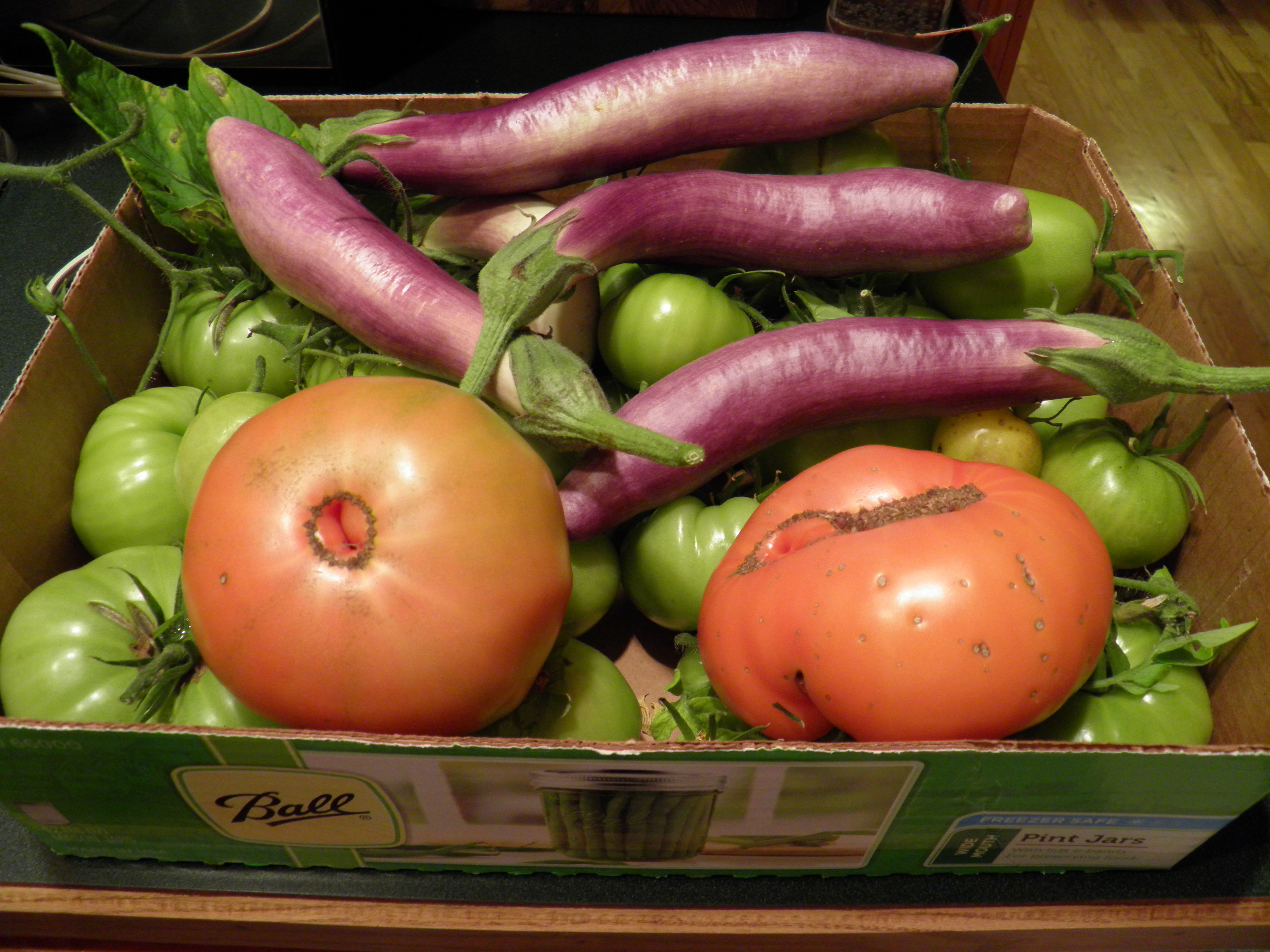
Most of us have a favorite way to use up Thanksgiving leftovers.  I’m freezing my leftover stuffing to use later this winter with the Cornish game hens I have in the freezer.  I usually make turkey soup, but yesterday, it occurred to me that I have all that green tomato salsa verde that I made earlier this fall, and why not use up the leftover carved turkey in some green enchiladas?   I hadn’t tried the sauce yet, and since I just picked another box of green tomatoes out of the greenhouse, I might want to make more of it.

OLYMPUS DIGITAL CAMERA

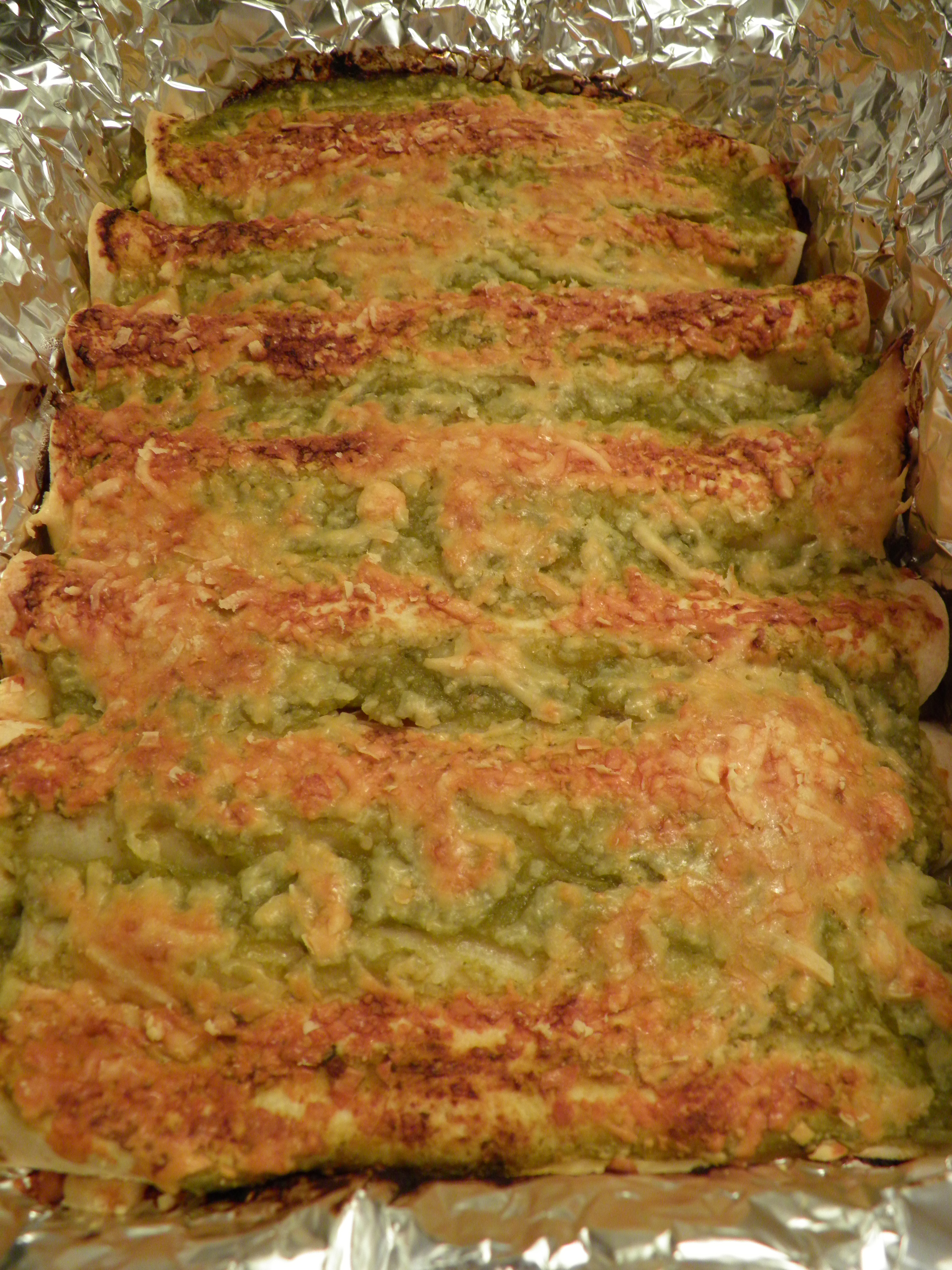
I made two pans of enchiladas, one with gluten-free tortillas for me, and one with flour tortillas for the rest of the family.   And they liked it quite a bit, so I might be making more salsa verde this week.

OLYMPUS DIGITAL CAMERA

I chopped three or four cups of leftover turkey, both white and dark meat, into bite-sized pieces.  This made six gluten-free enchiladas for me, and ten regular enchiladas for the family.  I had cheese already shredded in the freezer, so I used what I had, which was white cheddar.  My favorite cheese for green enchiladas is pepper jack, but Monterey jack is also good.  I lined my pans with foil because I plan to put any leftovers into the freezer for a quick, heat-up meal on rushed days.  The foil will allow me to lift the cooled enchiladas out of the pan, so I can wrap them with more foil and plastic for a tight seal.

Green Turkey Enchiladas

(makes 8-12 enchiladas)

1 pkg. medium-sized flour tortillas (12)

3 cups chopped turkey, light or dark meat or mixed

2 cups blended salsa verde (1 pint jar)

1 cup chopped onions

1 small can sliced black olives

2 cups shredded cheese

1 cup chunky salsa verde

Spray the bottom of a 13X9 inch pan with cooking spray (or oil it with a pastry brush) and spread a generous spoonful of sauce on the bottom of the pan.  Reserve a quarter cup of sauce for spreading on top.  Mix the rest of the sauce in a large bowl with the turkey, onions, chunky salsa verde, and olives.  It’s easiest to mix the cheese in at this point as well, reserving a quarter cup for the top.  What you end up with doesn’t look that tasty, but it will be, I promise.

Starting at one edge, place 3-4 tablespoons of the turkey filling mixture along the edge of the tortilla.  Roll it up and place it seam side down in the pan.  Continue until you have used all the filling mixture (you may have leftover tortillas).  Paint the tops of the enchiladas with the reserved sauce and sprinkle with reserved cheese.  Bake uncovered at 350 degrees for 30-45 minutes, or until enchiladas are bubbly and cheese is melted and golden brown.

OLYMPUS DIGITAL CAMERA

Serving suggestions:  Top with sour cream, more of the chunky salsa verde, chopped avocado, pico de gallo.  Black beans with garlic and lime make a nice side dish.  With a green salad, you have a complete meal.

This dish was a hit with the family.  We finished the meal with a recipe of my daughter’s, a pumpkin pie milk shake.  The first time she made this, she included the pie crust from the leftover pie, but we have since decided it’s better without the crust, so we make extra custard now specifically for this dessert.  We first used homestyle vanilla ice cream, but last year, we discovered that Dulce de Leche ice cream adds depth.  You can turn this into an adult drink with the addition of a shot per serving of the alcohol of your choice.  Rum, bourbon, or brandy are all good choices.  Of course, you can always just eat the pumpkin pie as is!

Amy’s Pumpkin Pie Milk Shake

OLYMPUS DIGITAL CAMERA

(makes about 4 one cup servings)

1 quart  of Dulce de Leche ice cream

1 cup milk

1 cup leftover pumpkin pie custard

whipped cream (optional)

Blend all ingredients together and pour into glasses.  Garnish with whipped cream.

Later this week, I will make turkey soup out of the pan drippings in the fridge and the two carcasses in the freezer.  If you’ve got a good recipe for using up Thanksgiving leftovers, I’d love to hear it.

Standard
Desserts, Main dishes, Recipes, Side dishes

Thanksgiving Dishes

OLYMPUS DIGITAL CAMERA

I’m always interested in what other people serve at the Thanksgiving feast.  Our dishes don’t vary much, but sometimes we add something new to the menu, or we’ll drop something that’s not that popular.  So this week, I’d like to share with you what’s on our menu this year, and I’ve got a couple of recipes for you that I really like, and a new one I’m trying for the first time.

We like to hang out together all day as the dinner cooks, but we’re not the type of folks who go for formal appetizers, so we just have a cold cuts and cheese and crackers tray and a pickle plate out on the counter.  For the pickle plate, I’ll bring jars of pickled beets, pickled spicy green tomatoes, some black and green olives, and either Joel or I will open jars of dilly beans and kosher dill pickles.  I’ll also be bringing jars of my home-canned, charred salsa and green tomato salsa to go with tortilla chips.  There will probably be potato chips and dip, too.

This year, I’m bringing a bottle of champagne and a bottle of either my raspberry cordial or blackberry cordial, or maybe both, to make pre-dinner champagne cocktails.  For the kids, I’ll make a lemonade-based punch.  At dinner, we always open bottles of sparkling cider.

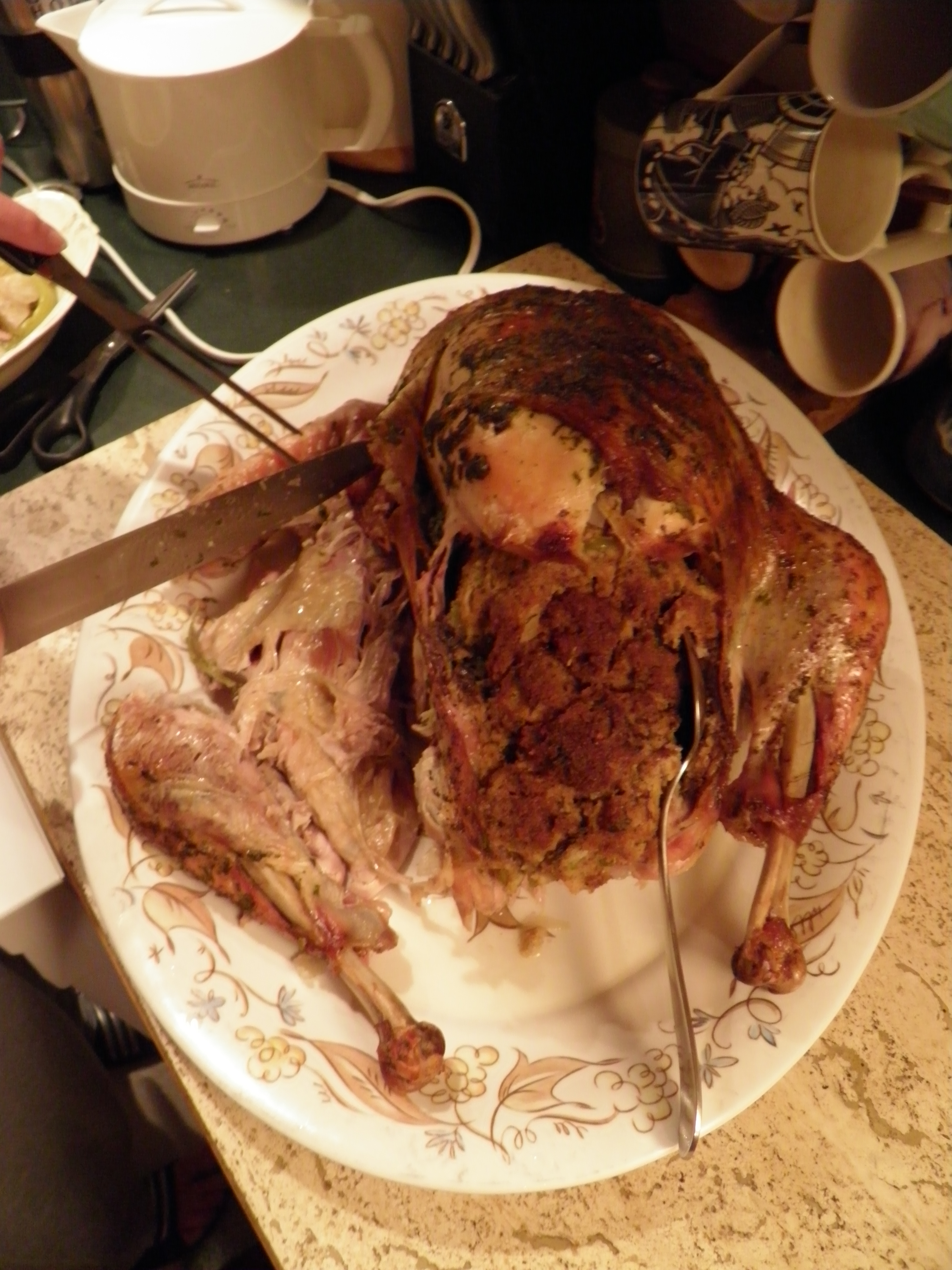
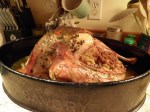
There’s turkey, of course.  We cook one at home for leftovers to feed the out-of-towners who stay at my house (our daughter, Amy, her husband, Solo, and his mother, Theresa).  Amy usually arrives a day early to help me with all the cooking.  For the last two years, my daughter-in-law, Tori, has cooked the turkey for the big family feast, and she’s done a marvelous job.  I taught her how to roast a chicken, told her to treat the turkey like a really big chicken, and she’s come through like a champ two years running.  This works well because we eat the feast at Tori and Joel’s house, and I don’t have to cook the turkey at my house and worry about then transporting it.  I have transported the entire dinner before, and I don’t like it!  I have also tried cooking it at someone else’s house, and I don’t like that, either.  So now, we divvy up the cooking, and it works well.

We are turkey traditionalists.  We season the bird with butter and herbs and roast it at 325 degrees in a big, old-fashioned, heavy-lidded, enamel roasting pan.   I like to mix fresh herbs from the garden—chopped thyme, sage, hyssop, and tarragon—into softened butter, and this goes under the skin of the breast and all over the bird outside.  I sprinkle it with sea salt and freshly ground black pepper.  I baste if I think about it, but the lidded roaster keeps the bird moist while producing a crispy skin, so if I forget to baste, it’s no big deal.
OLYMPUS DIGITAL CAMERA

I stuff my turkey with cornbread stuffing.  I make extra stuffing in a large casserole dish, and we take the casserole dish to the feast.  The stuffing that cooks inside the turkey stays at home for leftovers.  Tori doesn’t make stuffing, and her parents, who always feast with us, like a sausage and carrot and bread dressing, so they make and bring their favorite dressing.  Everybody has what he or she enjoys most.

Amy and I make most of the sides.  Amy has been crowned Mashed Potato Queen.  She has cooked and mashed the potatoes every year since she was a teenager.  Usually, she cooks the Yukon Golds I’ve grown in the garden.  But this year, all my Yukon Golds were volunteers (from a row Dennis didn’t dig the fall before!) and they matured so early that we had to eat them all this summer.  I have some garden reds, and I bought a 5 lb. bag of Golds, so we’ll mix them this year.  A handful of salt goes in the cooking water.  If this sounds like a lot, consider that if I don’t stop her, Amy fills my 13-quart stock pot with peeled and cut potatoes!  She puts lots of butter in them, and fat-free half & half to balance the fat in the butter.  She uses my old potato masher to break them up after draining, and then in goes the butter, and after it melts, the “cream.”  Then she uses the mixer to whip them up.  They are always light, fluffy, and creamy.  The key is to not overcook them.  Over-boiled potatoes will be gummy and gluey, no matter what else you do to them afterwards.

I make gravy from the turkey drippings.  I used to make turkey gravy with flour, but since I have stopped eating wheat, I’m reverting to cornstarch.  My mom had a funny rule:  cornstarch for light-colored gravies from poultry drippings, flour for dark-colored gravies from beef and venison.  (Of course, it was always flour for milk gravies, but that’s another story.)  I don’t know where she came up with this rule, but she never deviated from it.  At any rate, cornstarch makes a good, clear sauce for a light meat like turkey, and my turkey drippings are rich with butter and herbs from the herb butter I slather the turkey with, so it makes a delicious gravy no matter what you use to thicken it.

Some years, I make a puffy, sweet potato casserole.  My husband likes those overly-sweet yams with marshmallow topping, but he is the only one who does, so I don’t make it.  My kids don’t like sweet potatoes any way I fix them, but the puff is sometimes popular with other guests, and I really like it.  The recipe is at the bottom of this post.

This year, my son asked for a dish I love:  Roasted Roots.  I have to thank my dear foodie friend, DeAnna, for introducing me to Roasted Roots some years ago. This is a simple and easy dish, but you do have to have time to prep the vegetables and the oven space to cook it.  Tori and Joel have double ovens, so one oven will be free to roast the root vegetables and after that, to brown some homemade sourdough brown and serve rolls.  You can use any kind of root vegetables in Roasted Roots.  Our favorites are sweet potatoes, beets, parsnips, carrots, and onions, a cup of each vegetable, cut into chunks.  If you can get tender baby beets, there’s no need to peel or quarter them, just trim off the stem and root ends and scrub well.  If the beets are big and you can tell they’ve been out of the ground for a while, put on some rubber gloves, peel them, and cut them into approximately 1-inch chunks.  Peel the sweet potatoes, carrots, and parsnips, and cut them into chunks the same size as the beets.  Cut the onions into quarters, and then halve the quarters.  Put all the vegetables on a cookie sheet (or two, if you’re making a big batch) and throw on at least 6 garlic cloves, still in the paper.  (The paper helps keep them from burning.)  Drizzle 2 tablespoons of olive oil over the vegetables and toss them to coat.  I also like to mix a couple of tablespoons of balsamic vinegar or my homemade apple scrap vinegar with the olive oil before I toss the vegetables in it.  The vinegar really brightens the flavors, and the sugar in the vinegar helps the vegetables brown. Spread them out in a single layer, and sprinkle with salt and pepper.  If you have fresh herbs available, sprigs of thyme and/or rosemary are very good, tossed on top of the roots about 15 minutes into the cooking time.  Roast at 425 about 20-30 minutes, stirring at least once about halfway through, or until the beets, parsnips, and carrots are tender.  They are the hardest vegetables, so if they are tender, everything else will be done too.  The vegetables should be tender but should have browned and developed a crunchy outer “skin.”  Remove the herb sprigs before serving.  If you have more herb sprigs, a fresh bunch makes the dish look pretty.

We don’t make the traditional green bean casserole, but we do sometimes have green beans.  I like fresh green beans blanched and then tossed with mushrooms and onions sautéed in butter.  But this year, Joel is making the green beans.  He’ll probably use frozen beans, and he plans to crisp up some bacon and onions and sprinkle them on top of the cooked green beans.  They’ll be delicious.

I usually make some kind of fresh bread for Thanksgiving dinner.  I grew up with those packaged brown and serve rolls (my mom was not much of a bread baker), but I love fresh bread.  It’s one of the things I miss most about going gluten-free.  For the past several years, I’ve alternated between a loaf of herb bread–easy in the bread machine–made with herbs I picked from my garden and dried over the summer, and sourdough biscuits or rolls.  My old bread machine finally died this summer, so it’ll be sourdough rolls this year.  My sourdough starter also died because I didn’t use it or feed it enough, so I had to make some fresh starter.  The recipe for the starter and the brown and serve rolls comes from Tina Harrington’s Facebook page, Cooking on the Sagebrush Sea.  The recipe will appear at the end of this post.

I grew up with canned cranberry sauce, but the first time I tried homemade whole-berry cranberry sauce, I was hooked.  I make it every year, following the directions printed on the plastic bag of cranberries.  It’s just cranberries, water, and sugar.  So simple, but so delicious.  Some years, we make a fresh cranberry, orange, and apple relish as well.  It’s just equal parts chopped cranberries, peeled oranges, and shredded apples, mixed with just enough sugar, a half cup or so, to sweeten it to taste.  The problem with this relish is that it doesn’t keep well as a leftover, unlike whole-berry cranberry sauce, which will literally last months in the fridge.  (Yes, I’ve found it after 6 months in the back of the fridge and it is still good–a tribute, I guess, to the antioxidant power of cranberries.)  For this reason, you don’t want to make more of the fresh cranberry relish than you think you will eat on Thanksgiving Day.

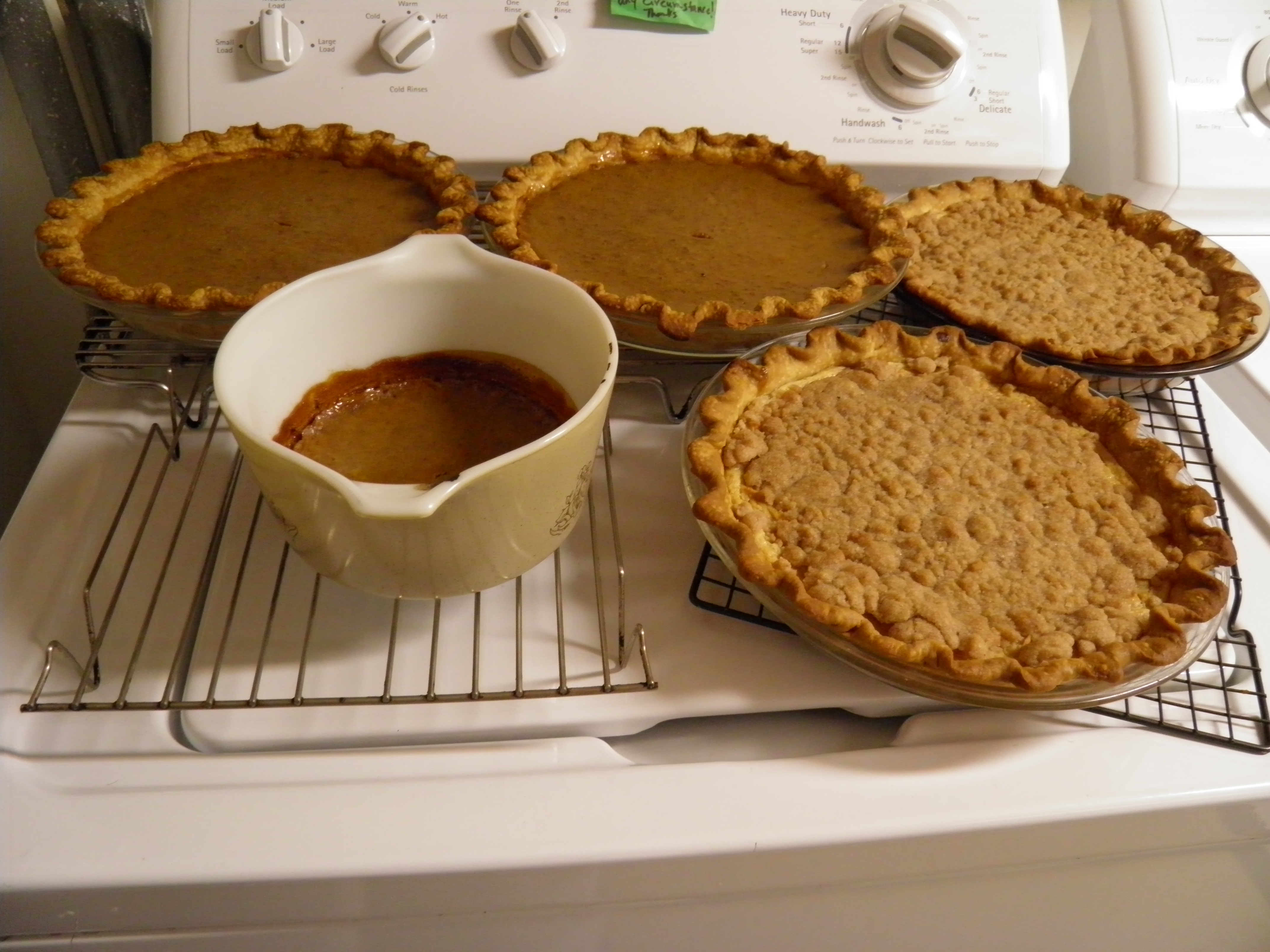
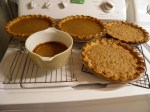
At this point, we come to desserts.  Amy and I bake the pies, and this year, my granddaughter, Kaedynce, will be helping with the pie-baking.  I have made so many kinds of pie for the feast over the years, including pecan, apple, strawberry-rhubarb, and the traditional pumpkin.  But there are two pies that everyone always wants:  pumpkin, of course, and sour cream apple.

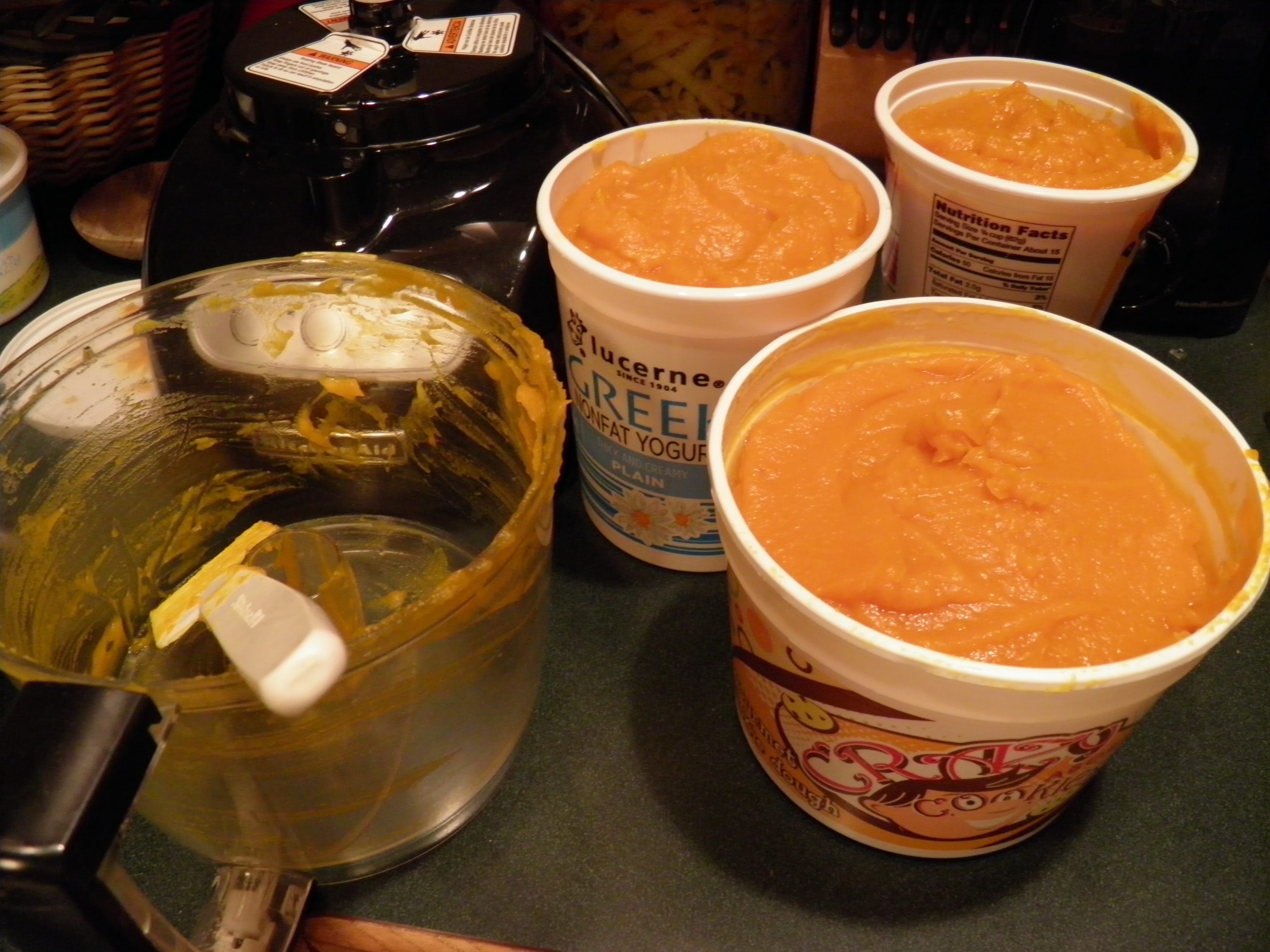
I grow pie pumpkins, and I roast and puree them for pumpkin pie filling.  I use the same recipe I grew up with—it’s on the back of the Libby’s pumpkin can—with one other exception besides growing and roasting my own pumpkins.  Goldie, my sister and pie baker extraordinaire, taught me to double the spices the recipe calls for.  Oh, yeah.  It’s fantastic!  And the home-grown, fresh-roasted puree puts the whole pumpkin pie deal right over the top.  It is sacrilege to put anything except freshly-whipped cream, just barely sweetened and with a touch of vanilla, on top of that pie.  So that’s what we do.

OLYMPUS DIGITAL CAMERA OLYMPUS DIGITAL CAMERA

I owe the sour cream apple pie recipe to my good friend, Wes Reid, who brought me one years ago that his partner, Lori, had made for us.  I fell in love with the thing, made it for Thanksgiving that year, and then the whole family fell in love with it too.  Now, it’s the first dessert to disappear.  Sour cream apple pie is in the chess pie family, and it’s topped with a cinnamon streusel that gets crispy under high heat during the last few minutes of cooking.  This is a custard-type pie made with sour cream, eggs, and shredded apples, and while it sounds odd, it is absolutely the bomb, sweet and tart and tangy, and very easy to make.  You’ll find the recipe at the end of this post.  My thanks to Wes and Lori for passing along this recipe from Lori’s family to ours.
OLYMPUS DIGITAL CAMERA

I usually make at least one other pie or dessert.  This year, I’ll be making my new love, pear mincemeat in a gluten-free pie crust.  Follow the links to previous posts that contain these recipes.  Pear mincemeat (no meat) is spicy, tart-sweet, with a great hit of citrus from the whole lemon ground up with the pears and other fruit.  It’s a wonderful filling for the gluten-free crust.  I like to make turnovers because they’re handy, literally, and bake up nicely, but a pie would be just as tasty.  I’ll see how busy I am on baking day.  A pie it’ll be if I don’t have time to form turnovers.  If I make turnovers, I’m thinking I might make a fresh lemon glaze to drizzle over them, to pretty them up a little bit and tempt someone who might be scared of the idea of “mincemeat” or gluten-free.

OLYMPUS DIGITAL CAMERA

It’s standard to ask a question at the end of a post, in an attempt to generate more comments.  I see it so much, it sort of feels like a cheap trick to me, and I’ve resisted the trend until now.  But now, I’m asking because I’m genuinely interested:  What’s going to be on your Thanksgiving table this year?  And if you’d like to share recipes or stories, so much the better.

And now, the recipes, in the order they were mentioned above.   I hope one or more of them makes it onto your Thanksgiving table, either this year, or in the future.

Sweet Potato Casserole

2 ½ lbs sweet potatoes

3 large eggs, lightly beaten

3 T. unsalted butter, melted (plus more for the pan)

2 T. dark brown sugar

1 t. salt

½ t. cinnamon

½ t. ginger

Pinch of nutmeg

Freshly ground black pepper

¼ cup chopped pecans

Preheat oven to 400 degrees.  Place scrubbed sweet potatoes on baking sheet, poke with fork three or four times.  Bake for 45-60 min. or until tender.  Set aside to cool.

Turn oven down to 350 degrees.  Scoop potato meat out of skins and into bowl.  Mash potatoes until smooth.  Add eggs, butter, brown sugar, salt, cinnamon, ginger, nutmeg, and pepper to taste.  Whisk mixture until smooth.

Butter 8X8 casserole dish or pan.  Pour sweet potato mixture into pan and sprinkle top with pecans.  Bake for 30-40 min., until a bit puffy.  Serve immediately.

Sourdough Starter and Brown and Serve Rolls

Sourdough Starter:  Mix 1 cup white all-purpose flour, 1 cup lukewarm water, 1/4 cup plain Greek yogurt, 1 tsp. active dry yeast in large bowl.  Leave out on the counter (or in warm place), covered with a cloth, until bubbling and yeasty smelling.  When mixture is frothy, scrape into a jar or lidded crock and refrigerate.  Starter is ready to use when a clear liquid has risen to the top of the jar.

It’s best to take the starter out the night before you plan to use it and feed it.  To feed starter, place in large bowl and stir in 1 cup of water and 1 cup of flour.  Cover and let sit in a warm place overnight to activate yeast cultures.  After measuring out the starter called for in the recipe, put the “fed” starter back in the jar or crock and back in the fridge.  Use your starter frequently, or at least feed it, or it will die.

Sourdough Brown and Serve Rolls

1 cup milk, scalded then cooled
3 tablespoons sugar
1 teaspoon salt
1/3 cup melted butter
2 tablespoons dry yeast
1 cup of activated (“fed”) sourdough starter
2 small or one large egg
4 ½ cups flour (white or whole wheat)

Mix milk, salt, sugar and butter in a microwave safe measuring cup.  Heat until the butter melts. Let this cool to room temperature. Add yeast and let proof five minutes, then combine with other wet ingredients and 2 cups of flour in bowl of stand mixer.  Let knead on the dough hook for ten minutes.  Add remaining flour in ½ cup increments until the dough just comes together. Turn out into a greased bowl, and proof (raise) for an hour. Make into rolls (makes about three dozen rolls). Place in greased pans a quarter inch apart, and let raise another 45 minutes.

For Brown and Serve: Preheat oven to 250*F and bake for 25 minutes. Let cool, and wrap and freeze (or refrigerate). When you want to serve these, take them out of the freezer and let them thaw for ten minutes, then bake at 425*F for 5-10 minutes.

Note:  An egg wash makes breads brown beautifully.  Simply beat up an egg with a spoonful of water and brush it onto bread before baking.  For the brown and serve option, use the egg wash prior to the second baking/browning.

Sour Cream Apple Pie

One 9” pastry shell, unbaked

2 tablespoons flour

1/8 teaspoon salt

¾ cup sugar

1 egg

1 cup sour cream

½ teaspoon vanilla

2 cups finely chopped or grated peeled apples (tart pie apples are best)

Mix dry ingredients, beat in egg, sour cream, and vanilla until smooth.  Add apples, mix well, pour into pastry-lined pie pan.  Bake in 400 degree oven for 15 minutes, then reduce heat to 350 degrees and bake for additional 30 minutes.

While custard is baking, mix the topping:

1/3 cup sugar

1/3 cup flour

1 teaspoon cinnamon

¼ cup softened butter

Mix well and sprinkle over pie. Return to oven at 400-425 degrees and bake for ten minutes to form streusel crust on top of custard.  Cool completely before cutting.  Store in fridge.

Standard
Gluten-free, Recipes, Side dishes

Conversions III: Gluten-free Cornbread Stuffing

I’m gearing up for Thanksgiving.  I bet you are, too.  I like tweaking recipes, but there are some recipes I don’t mess with.  I should rephrase that:  I am not allowed to change certain treasured family recipes, like my cornbread stuffing.  Both of my children (but especially my daughter, Amy), are adamant that the meal must stay pretty much the same as it was when they were kids.  Frankly, the only reason I’m changing my stuffing recipe is that I’ve changed.  I am no longer eating wheat, and that means I had to find an alternative to my beloved cornbread stuffing.  I’ll still make the traditional bread and cornbread stuffing for the family, but alongside, I’ll make this conversion to gluten-free for me.

The recipe starts with a gluten-free cornbread.  I use an inexpensive gluten-free all-purpose baking flour that I get in the bulk foods section at WinCo.
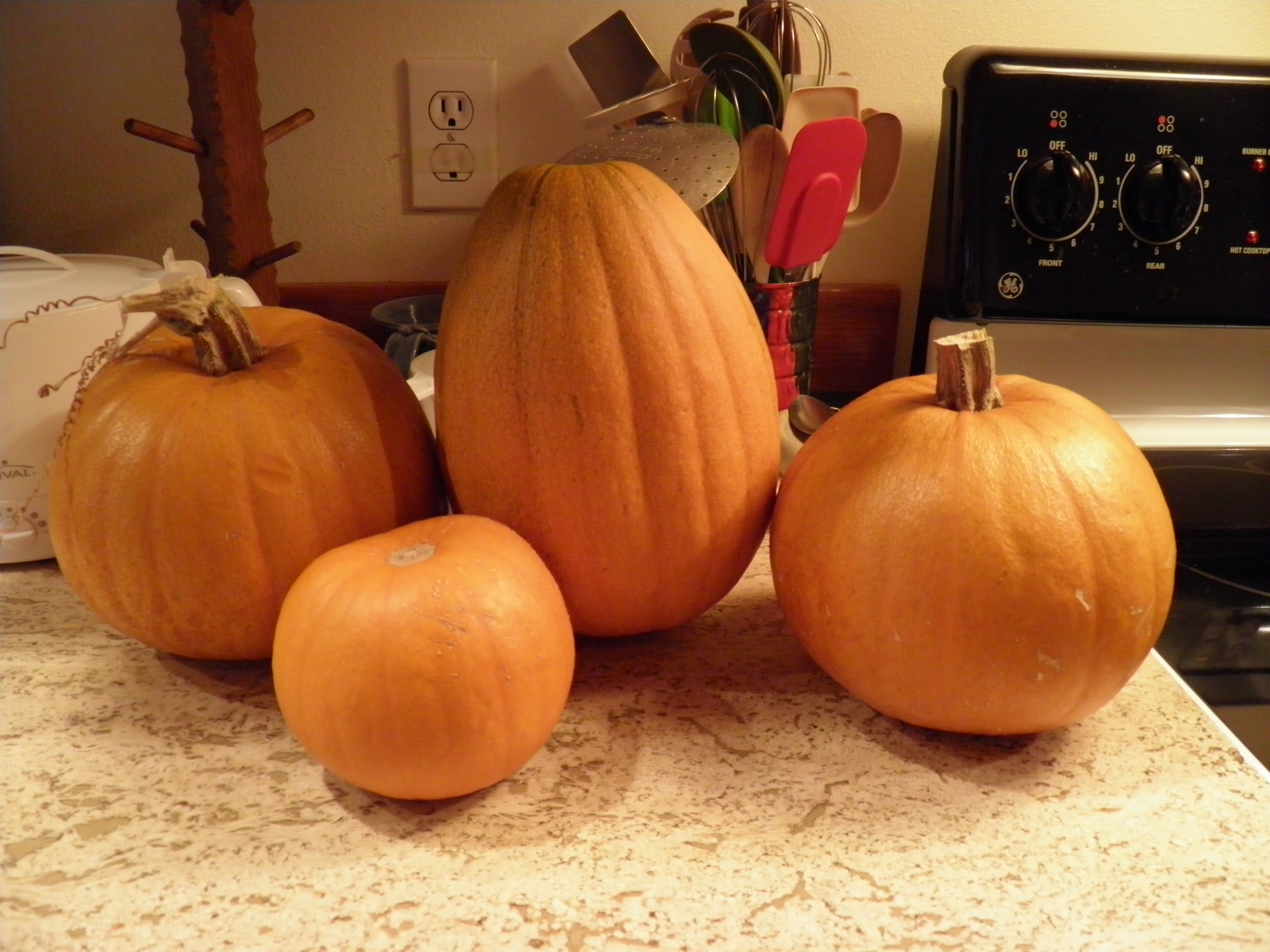
Gluten-free Cornbread

1 cup gluten-free all-purpose flour blend

1 cup cornmeal

1 tablespoon coconut flour

1/3 cup sugar (I use organic coconut palm–you can use whatever you like)

½ teaspoon baking soda

1 teaspoon salt

1 tablespoon apple cider vinegar

4 eggs

1/3 cup safflower oil

1/3 cup milk

Mix dry ingredients.  Mix wet ingredients, mix into dry.  Grease an 8-inch cast iron skillet. Pour batter into skillet and bake for 20-25 min. at 425 degrees.  (You may also bake the batter in a greased, 8 or 9 inch square pan—bake 20 min.—or in 12 greased muffin cups, fill half-full, bake 15 min.)  Remove and cool five minutes, remove cornbread from skillet by inverting over a plate.

Using a cast iron skillet to bake cornbread is a tradition in my family.  The advantage is that you get a really crispy crust on the bottom and sides, and this is delicious when you’re eating the cornbread as is (or with apple butter or honey, two of my favorites), as well as working beautifully in the stuffing.  That brown, crisp crust gives the stuffing more texture and flavor.  So if you have an iron skillet, grease it up and bake with it.

Another tradition in my family is to have beans and cornbread the night before a big feast day.  This works out nicely because I have leftover cornbread for the stuffing, as long as I make enough (or don’t let anybody have seconds)!

Gluten-free Cornbread Stuffing (Serves 4-6)

2 cups gluten free bread (Elana’s Pantry Paleo Bread) cut in ½ in. cubes and dried in oven on low heat

2 cups gluten free cornbread, crumbled

3/4 cup butter

1 medium onion, chopped

4 medium stalks celery, chopped

1 tablespoon poultry seasoning OR 1 ½ teaspoons dried, crumbled sage, ½ teaspoon dried thyme, 1 teaspoon dried parsley

1 teaspoon salt

½ teaspoon pepper

3 eggs, lightly beaten

1-2 cups chicken stock

Melt butter in saucepan, add chopped onion and celery, cook until tender.  Mix bread cubes and cornbread cubes in large bowl.  Sprinkle with salt, pepper, and herbs, mix.  Mix butter and vegetables into breads, folding carefully to keep cubes from losing their shape.  Carefully fold eggs into bread mixture.  Add enough chicken stock to moisten stuffing mixture.  Don’t let the mixture turn into a paste.  Mix gently to keep bread cubes intact.

The stuffing may be inserted into the cavity of a chicken or turkey or baked in a greased, uncovered casserole dish alongside the bird at 325-350 degrees for 30-40 minutes or until top is browned and crusty.  (Yeah, I know.  Everybody’s scared of cooking stuffing inside the turkey.  All I can say is I’ve been doing it almost 50 years, and nobody has ever gotten sick.  But follow your own inclinations on this one.)

I’ve used this recipe for years with wheat-based bread cubes and cornbread made from half wheat flour and half cornmeal. Here’s a picture of last year’s Thanksgiving turkey with the same stuffing made with wheat bread cubes and traditional cornbread.

OLYMPUS DIGITAL CAMERA

I apologize that there are no pictures of the gluten-free stuffing, but honestly, it looks just like what’s in the picture above.  Unfortunately, I got distracted by football and didn’t get any pictures while I was making the gluten-free stuffing.  Our team lost–another distraction–and as consolation, we ate up the test batch (stuffed into a pair of Cornish game hens) before I could get pictures of it.  Maybe that’s the best testimonial of all.

I’m so happy that I don’t have to give up my treasured cornbread stuffing this year because I’m no longer eating wheat.  I can make the kids happy and satisfy myself at the same time.  Dennis doesn’t care either way; he’s like Mikey.  He’ll eat anything.

Standard